



Europe’s push toward tokenized finance will require central bank-backed settlement infrastructure, according to European Central Bank Executive Board member Piero Cipollone.
Speaking in Brussels, Cipollone said tokenized deposits and stablecoins cannot support large-scale financial markets on their own. Without access to tokenized central bank money, transactions may settle in assets that carry credit or price risk, limiting broader adoption.
“Without tokenised central bank money, a seller of a tokenised security may receive payment in an asset they are not comfortable holding,” Cipollone said.
Pontes project to support settlement
Cipollone pointed to the Eurosystem’s Pontes initiative, which is designed to link distributed ledger technology (DLT) platforms with TARGET Services and enable settlement in central bank money.
The ECB expects an initial rollout of Pontes in the third quarter of 2026. The system is intended to give market participants a way to settle tokenized transactions using central bank-backed assets rather than private digital money.
The project builds on the ECB’s broader Appia initiative, published earlier this month, which outlines a plan for a European tokenized financial ecosystem by 2028.
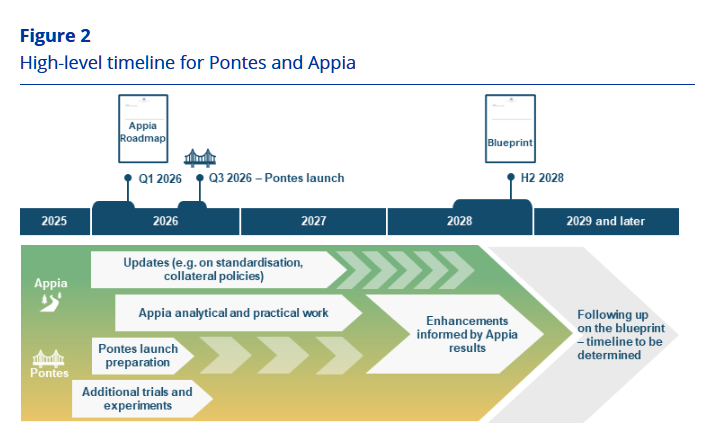
“With Appia, we are building a road from today’s financial system to tomorrow’s tokenised markets, firmly grounded in central bank money,”
Legal framework remains a gap
Beyond settlement infrastructure, Cipollone highlighted the need for clearer legal standards across the European Union.
One element of the Appia roadmap focuses on interoperability, aiming to ensure tokenized assets can move across different platforms using shared data formats and smart contract standards.
He also called for closer coordination between public institutions and private sector participants, including banks, custodians, and technology providers.
“In my view, three conditions must be met. First, a safe settlement anchor that enables scale and innovation. Second, a genuine public-private partnership. And third, a legal framework that matches the technological ambition.”
While the European Commission has proposed extending the DLT Pilot Regime, Cipollone said a broader framework may still be needed to support issuance and transfer of tokenized assets across the bloc. Without it, market infrastructure could develop unevenly under fragmented regulations.
Industry feedback builds
The discussion comes as industry participants push for adjustments to existing rules. Stablecoin issuer Circle recently submitted feedback to the European Commission, calling for an expanded DLT Pilot Regime and access to cash account services for regulated crypto firms.
The ECB’s position places central bank money at the center of Europe’s tokenization strategy, particularly as private digital assets continue to play a larger role in financial markets.
 Oleksii Shumak
Disclaimer: All materials on this site are for informational purposes only. None of the material should be interpreted as investment advice. Please note that, despite the nature of much of the material created and hosted on this website, HODL FM operates as a media and informational platform, not a provider of financial advisory services. The opinions of authors and other contributors are their own and should not be taken as financial advice. If you require advice, HODL FM strongly recommends contacting a qualified industry professional.