





The Bank of England is stepping up efforts to modernize the U.K.’s core payment and settlement infrastructure by inviting private sector participants to test tokenized asset settlement on distributed ledgers.
The initiative, known as the Synchronisation Lab, aims to explore how the central bank’s next-generation RTGS system could interact with external blockchain platforms in a safe, non-live environment.
Testing synchronized settlement
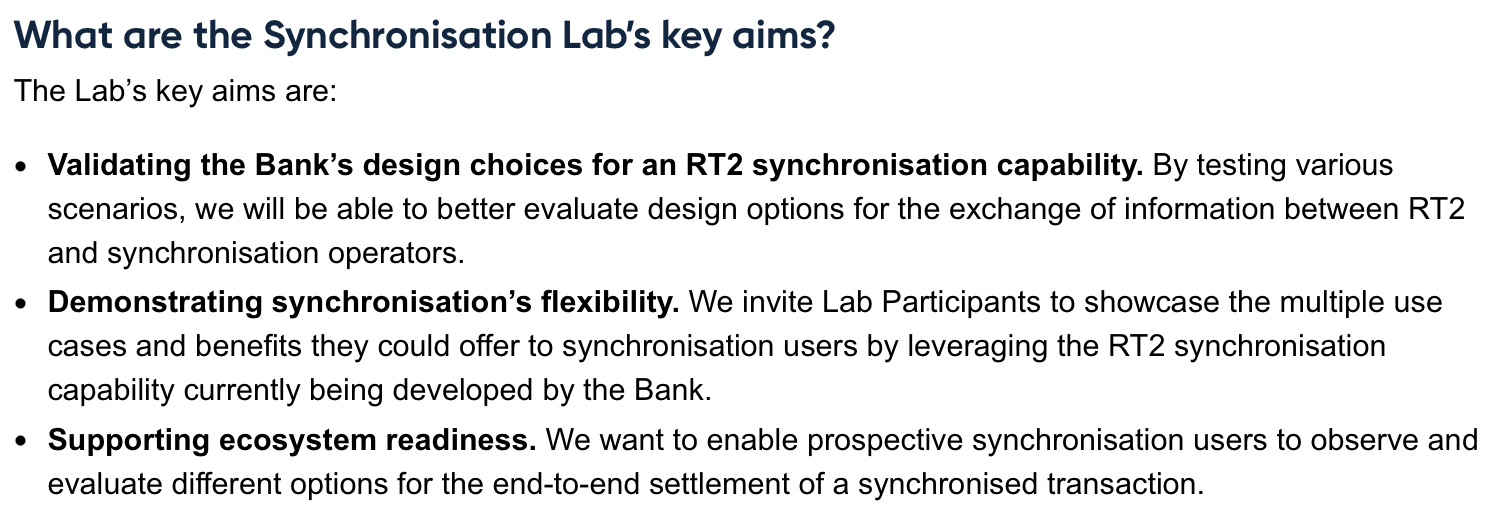
Scheduled to run for six months starting in spring 2026, the Lab brings together 18 organizations, including banks, market infrastructure providers, fintechs, and Web3 companies.
It was first announced in October 2025, following a strong wave of industry applications from firms interested in demonstrating use cases and business models for synchronized settlement. Participants can simulate end-to-end settlement flows without using real funds, testing use cases that include tokenized securities, collateral optimization, foreign exchange, and digital-money issuance.
The Bank said the initiative builds on previous experiments, including Project Meridian, which demonstrated that the concept of a synchronization operator is technically feasible and can facilitate atomic settlement in central bank money.
Web3 and fintech involvement
Several Web3 and fintech firms are participating in the pilot. It was announced that Chainlink and UAC Labs are testing decentralized coordination approaches for synchronized settlement, while Ctrl Alt and Monee focus on tokenized gilts and other securities. Tokenovate and Atumly are exploring conditional margin payment workflows and digital-money issuance processes, and global institutions such as Swift and LSEG are also involved.
The Lab encourages participants to demonstrate their end-to-end propositions and, where possible, emulate real market actors to evaluate practical outcomes for future synchronised transactions.
JUST ANNOUNCED: Chainlink has been selected to participate in the Bank of England’s Synchronisation Lab.
— Chainlink (@chainlink) February 10, 2026
Chainlink is supporting synchronized settlement between central bank money and onchain securities.
This is how the UK financial system moves onchain. pic.twitter.com/b3ho0gN1DY
Chainlink Official Announcement on this innitiative.
Global context and digital innovation
The Federal Reserve and Bank for International Settlements, for example, have explored smart contracts for programmable settlement in Project Pine, while Singapore’s BLOOM initiative focuses on tokenized bank liabilities and regulated stablecoins.
Wholesale CBDC trials are underway in Australia, and cross-border digital currency experiments, such as China-led mBridge, have already processed tens of billions in transactions.
Although the Synchronisation Lab does not involve real-money payments and is not a regulatory sandbox, it represents a significant step in preparing the U.K. financial ecosystem for the potential adoption of tokenized assets, digital money, and programmable settlement mechanisms.
 Tanya Petrusenko
Disclaimer: All materials on this site are for informational purposes only. None of the material should be interpreted as investment advice. Please note that despite the nature of much of the material created and hosted on this website, HODL FM is not a financial reference resource, and the opinions of authors and other contributors are their own and should not be taken as financial advice. If you require advice. HODL FM strongly recommends contacting a qualified industry professional.