



Argentina has ordered a nationwide block of Polymarket after a court concluded the platform operated as an unregulated betting system and raised concerns over suspicious trading tied to official inflation data.
The decision follows an investigation into unusual activity ahead of the country’s February inflation release. Authorities now require internet service providers to restrict access to the platform, while Google and Apple must remove related mobile applications from their stores for users in Argentina.
Local media outlet Clarín reported that the measure applies nationwide, which makes Argentina the first country in the region to enforce a full restriction on the platform.
Suspicious bets ahead of inflation data trigger scrutiny
The case centers on Argentina’s February consumer price index, published by INDEC on March 14. The agency reported a 2.9% inflation rate, above forecasts of 2.7%.
Investigative reporting by DL News identified unusual trading patterns on Polymarket in the 48 hours before the release. Several accounts that usually placed small, diversified bets shifted to concentrated positions on the exact 2.9% outcome. Total wagers reached $27,885 on that specific result.
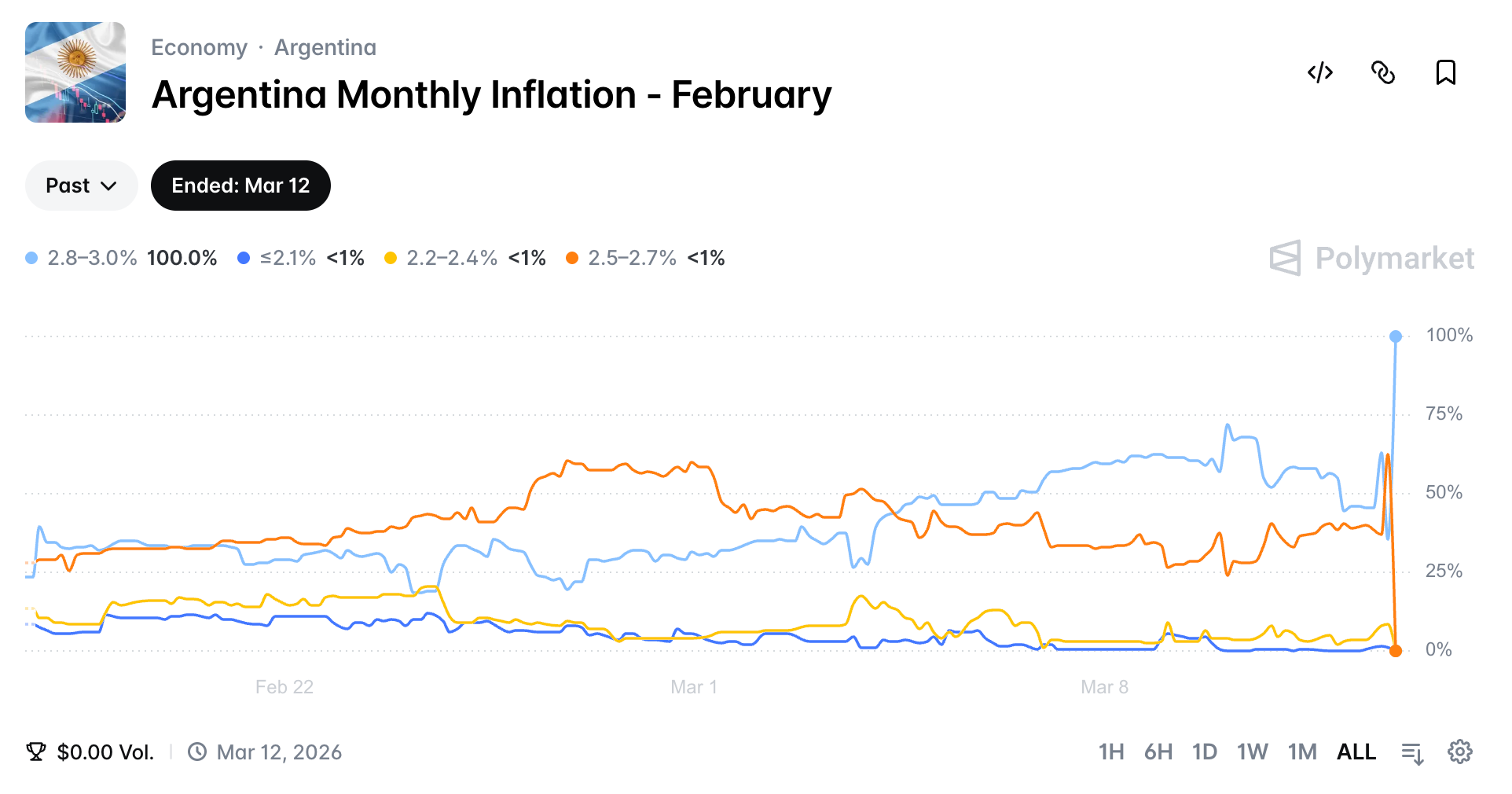
Authorities also pointed to a last-minute shift in predictions. Local reports state that market expectations reversed roughly 15 minutes before the official data release, aligning with the final figure. That timing made people worry about the possibility of getting to private information.
Prediction markets allow users to trade on real-world outcomes. In this case, participants bought “Yes” shares on whether inflation would exceed 2.7%. When INDEC confirmed 2.9%, those positions paid out at full value.
The court classifies the platform as an unregulated betting system
The Buenos Aires court ruled that Polymarket functioned as an online betting platform rather than a neutral prediction market. The case followed complaints from the Buenos Aires City Lottery and the Argentine Chamber of Casinos and Bingos.
Authorities cited multiple risks in their decision. These include the use of cryptocurrency payments, credit card deposits, and the absence of strict identity or age verification. Officials warned that such gaps could allow minors to access the platform.
The court instructed the national telecom regulator ENACOM to coordinate enforcement with internet providers. The order also requires app store restrictions to limit access for both new and existing users.
Insider trading concerns point to a regulatory gap
The allegations have renewed attention on insider trading risks within decentralized platforms. Traditional financial markets operate under strict surveillance systems and disclosure rules. Prediction markets do not fit neatly within those frameworks.
Polymarket operates through blockchain-based infrastructure, which allows global access and pseudonymous transactions. These features complicate oversight and user identification.
The case in Argentina shows how access to early economic data could create direct profit opportunities. Economic indicators such as inflation influence currency markets, bond pricing, and monetary policy expectations. It makes them highly sensitive before official publication.
Argentina has faced past controversies related to economic data. Between 2007 and 2015, the government faced accusations of manipulating inflation figures. Reforms introduced after 2016 aimed to restore the credibility of INDEC and its processes. The current claims don't involve changing data, but they do bring up concerns about data privacy and security.
Limited global impact despite regulatory action
The block restricts access within Argentina, but its effect on Polymarket’s overall activity remains limited. The platform recorded $3.02 billion in monthly trading volume in October 2025, which places national-level participation as a small share of total flows.
The restriction represents a regulatory action rather than a systemic shock to global liquidity. However, it adds to a growing list of jurisdictions that have taken action against the platform. Colombia and Romania have also imposed bans, citing unauthorized gambling activity.
Regulators in parts of the United States have examined whether event-based contracts fall under gambling or derivatives laws. The uncertainty surrounding the classification of prediction markets within current legal systems is reflected in these discussions.
Broader implications for prediction markets
The Argentine case shows a structural tension within prediction markets. Prediction market platforms aim to aggregate information through trading activity, but they also create incentives for information leakage.
Economic data markets present a clear example. Access to official statistics before publication can lead to immediate financial gain. The concentrated bets on Argentina’s inflation figure illustrate how even relatively small amounts of capital can exploit that advantage.
The platform also faces scrutiny over other markets tied to sensitive events, including geopolitical developments. Some contracts have attracted significant volume shortly before key developments, which has led to further concerns about information flow and market integrity.
Unresolved questions remain
Authorities in Argentina have not publicly identified the individuals behind the suspicious trades. The investigation focuses on whether government insiders or affiliated actors accessed confidential data before its release.
For now, the court’s decision addresses platform access rather than individual accountability. The broader issue of enforcement remains complex due to the cross-border nature of blockchain-based platforms.
The outcome of this case may influence how other jurisdictions approach prediction markets. It also places pressure on platforms to strengthen internal monitoring and transparency.
Argentina’s move reflects a clear stance on consumer protection and market oversight. At the same time, it shows how current regulatory systems don't work well with decentralized financial tools.
 Anastasiia G
Disclaimer: All materials on this site are for informational purposes only. None of the material should be interpreted as investment advice. Please note that, despite the nature of much of the material created and hosted on this website, HODL FM operates as a media and informational platform, not a provider of financial advisory services. The opinions of authors and other contributors are their own and should not be taken as financial advice. If you require advice, HODL FM strongly recommends contacting a qualified industry professional.