


Geopolitical tensions between the United States and Iran have entered a volatile new phase, with prediction markets, oil prices, and crypto assets all reacting to a rapid stream of conflicting signals.
Data from Polymarket shows that the odds of a US invasion of Iran climbed to 63% on Sunday. The figure marks a sharp rise in market-implied probability, though still below the recent peak of 68% recorded on March 29 during a period of troop buildup and speculation around potential US control of Kharg Island, a key Iranian oil export hub. Trading volume tied to this outcome reached approximately $3.74 million.
Conflicting messages drive uncertainty
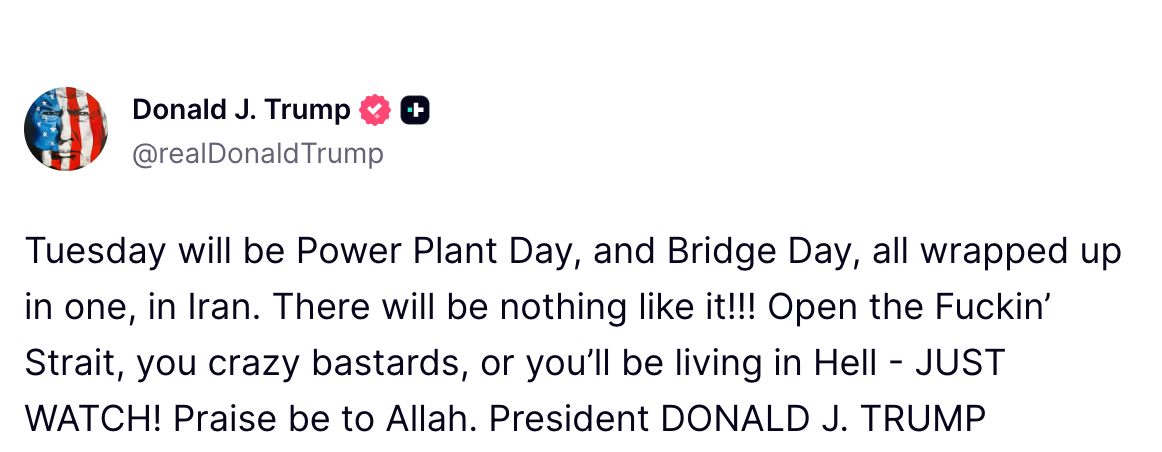
US President Donald Trump has issued a series of statements that have added to the uncertainty. In a Truth Social post on Sunday, he warned:
“Tuesday will be Power Plant Day, and Bridge Day, all wrapped up in one, in Iran. There will be nothing like it!!! Open the fuckin’ Strait, you crazy bastards, or you’ll be living in Hell.”
The warning came after earlier remarks suggesting a possible diplomatic breakthrough. In a Fox News interview, Trump said Iran is “negotiating now” and pointed to a “good chance” of a deal within 24 hours. He also added,
“If they don’t make a deal and fast, I’m considering blowing everything up and taking over the oil.”
Axios reported that US and Iranian officials, alongside regional mediators, are discussing a potential 45-day ceasefire. The proposal could serve as a pathway toward ending the conflict, which has now extended beyond a month.
Iranian officials have not confirmed any agreement. Statements from Tehran indicate a willingness to respond directly to any attack on infrastructure. Foreign Ministry spokesperson Esmail Baghaei stated:
“Our armed forces have made it clear that in case Iran’s infrastructure is attacked, we would react in kind...Our armed forces would target any similar infrastructure that is owned or in any way or manner related to the United States or contributes to their act of aggression against Iran.”
Strait of Hormuz disruption fuels oil surge
The closure of the Strait of Hormuz has become a central pressure point in the conflict. The waterway accounts for roughly 20% to 30% of global oil transit, and its shutdown has triggered a sharp rise in energy prices.
Brent crude oil climbed above $109 per barrel last week and approached $112 on Monday morning. The sustained increase has already translated into higher fuel costs. Estimates suggest that US consumers have spent an additional $240 million per day on fuel since the conflict began on Feb. 28.
The Kobeissi Letter indicated that if current oil prices persist for several more weeks, US inflation could rise to around 3.7% based on Consumer Price Index projections.
Iran has signaled it may keep the strait closed while considering transit tolls to offset war-related damage. Officials have also suggested that reopening could depend on compensation mechanisms tied to infrastructure losses.
Crypto markets react to headlines
Cryptocurrency markets have mirrored the uncertainty, reacting quickly to both escalation risks and ceasefire optimism. Total crypto market capitalization rose roughly 2.5%, adding about $70 billion to reach $2.44 trillion in early Monday trading.
Bitcoin climbed as high as $69,500 before stabilizing near the $69,000 range. The move triggered significant liquidations, particularly among short traders. Data from CoinGlass shows that about $250 million in positions were liquidated over 24 hours, with roughly 73% coming from shorts.
Ether outperformed major tokens with a 3.7% gain, while Solana, XRP, and Dogecoin also posted moderate increases.
Market positioning ahead of the weekend had turned heavily bearish. Liquidation data shows that nearly three times as many short positions as long positions were wiped out, indicating that traders had expected further downside before the sudden reversal.
Prediction markets face scrutiny
At the same time, prediction markets themselves have come under pressure. Polymarket removed a controversial listing tied to the rescue of US service members in Iran after backlash from lawmakers.
Representative Seth Moulton criticized the market, calling it “disgusting” and arguing that it turned a military operation into a financial instrument. The company stated that the listing failed to meet internal integrity standards and was taken down shortly after appearing.
The incident adds to growing regulatory attention on prediction markets in Washington. Lawmakers have introduced proposals to restrict contracts linked to war, elections, and government actions, citing concerns over national security and market manipulation.
Fragile balance between escalation and resolution
Markets now sit at a fragile intersection of escalation risk and diplomatic possibility. Oil remains elevated, crypto shows signs of reactive momentum, and prediction markets continue to price in significant uncertainty.
Bitcoin’s recent gains have not yet broken it out of the range established since the conflict began, with resistance levels still intact. The same applies to broader financial markets, where brief rallies have followed optimistic headlines but failed to establish sustained direction.
The next phase depends heavily on whether ceasefire discussions materialize into a formal agreement or collapse under renewed threats. With deadlines shifting and rhetoric intensifying, investors continue to navigate a landscape defined by rapid reversals and high-stakes uncertainty.
 Tanya Petrusenko
Disclaimer: All materials on this site are for informational purposes only. None of the material should be interpreted as investment advice. Please note that, despite the nature of much of the material created and hosted on this website, HODL FM operates as a media and informational platform, not a provider of financial advisory services. The opinions of authors and other contributors are their own and should not be taken as financial advice. If you require advice, HODL FM strongly recommends contacting a qualified industry professional.