


Prediction market platforms recorded more than 191 million transactions in March 2026, a figure that already represents a 2,838% increase from the same period last year, according to data tracked by Dune Analytics. Monthly notional trading volume reached roughly $23.9 billion, up from $1.9 billion at the same time in 2025, though still about 12% below January's all-time high of $26.7 billion.
Monthly active users climbed to 865,411 in March, compared with 396,642 a year earlier, a 118% year-over-year increase. The surge in participation is not limited to existing users placing larger bets. Monthly unique wallets nearly tripled to around 840,000 by February 2026, a trend that blockchain intelligence firm TRM Labs described in a Friday report as "a broad expansion of the participant base."
Crypto niche to geopolitical trading floor
The character of activity on these platforms has shifted. Contracts tied to US politics, macroeconomic decisions, and international conflicts now account for the majority of trading volume. On Polymarket, the five highest-volume contracts as of this week center on who the major US political parties will nominate for the 2028 presidential race and whether Israeli Prime Minister Benjamin Netanyahu will remain in office by year-end.
TRM Labs noted the change directly:
"Geopolitical events, US politics, and macroeconomic decisions account for the majority of trading volume. Crypto-native topics, while prevalent, now represent a smaller share of overall activity."
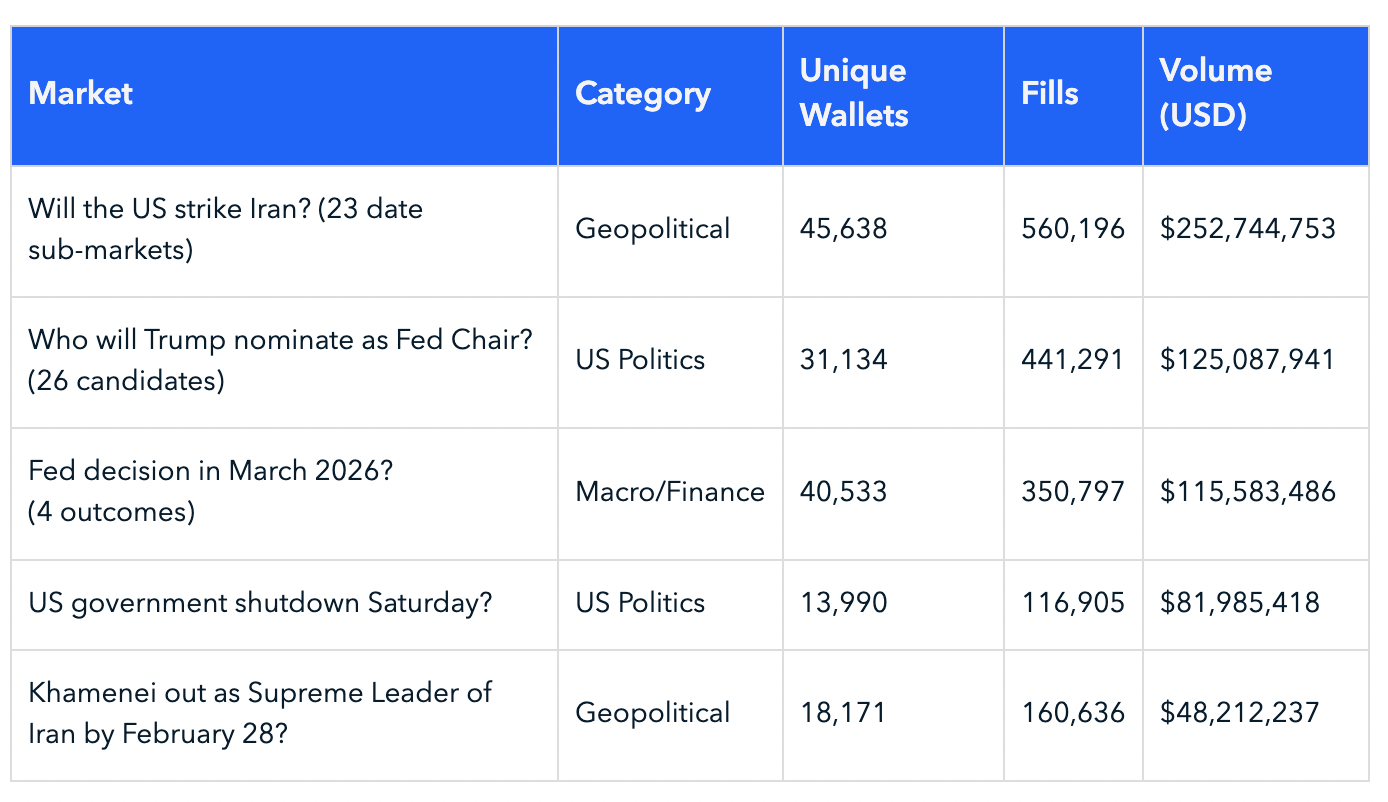
A single market on Polymarket, "Will the US strike Iran?", attracted $252.7 million in volume in February alone across 23 date sub-markets, drawing 45,638 unique wallets and 560,196 fills, according to TRM Labs data. On February 28, Polymarket set a single-day volume record of $425 million, surpassing the prior high from Election Day 2024. The record was driven almost entirely by Iran-related markets resolving simultaneously.
The "Khamenei out as Supreme Leader of Iran by February 28" market went from $23,000 in volume on February 27 to $29.6 million on February 28, a 1,275x increase in a single day, the largest day-over-day spike ever recorded on the platform, per TRM Labs.
How the platforms grew their reach
The path to this scale involved a series of legal and commercial developments that opened prediction markets to a far wider audience. In October 2024, a US court ruled that Kalshi could legally offer election contracts. The platform relaunched within hours, 32 days before the presidential election, and the press coverage that followed gave the sector a proof-of-concept moment.
In January 2025, Kalshi launched sports event contracts in all 50 states. A subsequent partnership with Robinhood brought prediction markets to its 27 million funded brokerage accounts. Super Bowl-related volumes on those platforms exceeded $1 billion alone. By February 2026, a new CFTC chairman withdrew proposed rules restricting prediction markets, and Polymarket received a no-action letter from the CFTC. In October 2025, ICE/NYSE, parent of the New York Stock Exchange, announced a strategic investment of up to $2 billion in Polymarket at an $8 billion valuation.
Google Finance subsequently embedded live Polymarket and Kalshi odds. Prediction market prices began appearing in mainstream news coverage, and the cycle reinforced itself when Polymarket's CEO appeared on 60 Minutes.
TRM Labs said the sector "has grown significantly with Google Finance and mainstream media coverage of live odds," adding:
"Prediction markets have scaled rapidly due to improved accessibility, regulatory developments, and integration with mainstream platforms. They are increasingly used as real-time indicators of geopolitical and macroeconomic events."
Who trades and how
On Polymarket, more than 57% of users trade less than $100 per position. The average active participant executes roughly 25 trades per day, a frequency that mirrors patterns in retail stock trading rather than traditional betting, according to behavioral data cited in the March report.
TRM Labs broke down the Polymarket user base by experience level. Wallets with between 11 and 1,000 lifetime fills accounted for 44.7% of all trades and $869 million in volume. Wallets with over 10,000 fills, consistent with algorithmic market makers, accounted for 35.2% of trades and $774 million in volume. First-time bettors who placed just a single trade represented less than 0.2% of activity and only $3.5 million in volume.
The median trade size reflected the same stratification. First-time bettors placed median bets of $30, while the most active wallets placed a median of just $12 per trade, a pattern consistent with high-frequency participants capturing spreads rather than taking large directional positions.
On Kalshi, its exotics category overtook politics in late February, pushing it into the platform's top three categories by weekly volume, according to Dune data.
Regulatory pressure and market integrity concerns
Growth has come alongside mounting scrutiny. Nevada gaming regulators sued Kalshi in February 2026. The Arizona attorney general filed lawsuits against Kalshi in March 2026. Multiple bills were introduced in March alone, targeting issues from insider trading to proposed bans on war-related contracts. US lawmakers also unveiled a bipartisan bill to ban event contracts that resemble what the legislation called a "casino-style game."
TRM Labs documented transaction patterns that raise questions about coordination ahead of the February 28 US airstrikes against Iran. Four wallets collectively turned roughly $40,000 into $872,000 by betting on US military action against Iran in January and February 2026. All four entered markets priced between $0.10 and $0.80 per share and redeemed at $1.00 when markets resolved. All four funded their positions through the same bridge within a narrow time window. After collecting winnings, all four swept their balances and did not re-enter the market.
TRM Labs was direct about what the data does and does not show:
"These findings do not prove insider trading, but they show that on-chain data can surface anomalies that warrant further investigation."
On March 23, both Polymarket and Kalshi announced plans to introduce trading guardrails. The broader regulatory outlook, however, remains unresolved.
TRM Labs framed the stakes:
"Looking ahead, prediction markets have the potential to evolve beyond speculative platforms into core infrastructure for real-time information aggregation and risk pricing. As liquidity deepens and participation broadens, these markets could increasingly serve as forward-looking indicators for policy decisions, geopolitical developments, and macroeconomic trends — complementing, and in some cases competing with, traditional forecasting tools."
 Oleksii Shumak
Disclaimer: All materials on this site are for informational purposes only. None of the material should be interpreted as investment advice. Prediction market trading involves substantial financial risk, and participants may lose some or all funds committed to a position. The regulatory status of these platforms varies by jurisdiction and remains subject to change, with several platforms currently facing active legal challenges. Despite the nature of much of the material created and hosted on this website, HODL FM operates as a media and informational platform, not a provider of financial advisory services. Anyone considering participation in prediction markets should verify local regulations and consult a qualified industry professional before committing funds.