




Global markets opened on Monday, January 26, under mounting pressure as gold surged beyond $5,000 per ounce for the first time in history, while equities and cryptocurrencies showed renewed strain. The move capped one of the strongest monthly rallies for precious metals on record and underscored a sharp divergence between traditional safe havens and risk-linked assets.
Gold climbed more than $650 in January alone. Prices recorded an 8.5% weekly gain, the largest dollar increase ever, and the biggest percentage rise since the March 2020 pandemic shock. Silver also crossed historic territory, topping $100 per ounce and rising more than 44% since the start of the year, according to market data.
The rally unfolded amid a convergence of geopolitical tension, currency instability, and political uncertainty in the United States. Investors responded with a broad shift toward assets viewed as resilient under systemic stress.
Geopolitical risk and currency pressure fuel demand
Gold demand strengthened during renewed tariff threats from US President Donald Trump, including a warning of 100% tariffs against Canada following Ottawa’s limited trade accommodation with China. Tensions also rose after earlier disputes involving Greenland, Venezuela, and Iran, all cited by analysts as factors that unsettled markets.
The yen added to the pressure. The currency traded near multi-decade lows against the pound and record lows versus the euro, reflecting Japan’s ultra-low interest rate stance. Japanese officials warned against “abnormal moves,” while reports suggested communication between US and Japanese financial authorities on exchange-rate conditions. Markets viewed the signals as a prelude to possible intervention.
Another layer of uncertainty emerged from the Federal Reserve. Its January rate decision approached amid a criminal investigation involving Chair Jerome Powell, whose term ends in May. US media reports suggested that President Trump may announce a successor nomination soon, a move that could raise questions about central bank independence.
Ipek Ozkardeskaya, senior analyst at Swissquote, said:
“There has been no new escalation over the weekend - no fresh breach of international law, no invasion, no immediate military threat."
“The US did, however, threaten Canada with 100% tariffs, after Mark Carney approached China last week, defying the White House - a reminder that trade tensions remain alive and well. Beyond that, the news flow is thin. Yet the bid for precious metals suggests that market stress is far from over.”
Equities show selective weakness
US stock futures pointed lower as trading began, with investors bracing for a dense earnings week led by Microsoft, Meta, Tesla, and Apple. The previous session showed sharp divergence across indices.
The Nasdaq closed Friday with a narrow 0.28% gain at 23,501.24. The S&P 500 edged up 0.03% to 6,915.61. The Dow Jones Industrial Average fell 285.30 points, or 0.58%, to 49,098.71 after Goldman Sachs dropped nearly 4%.
The uneven performance reflected caution toward broad exposure, particularly as valuations remained elevated and macro risks intensified.
Crypto markets face confidence shock
Cryptocurrency markets moved in the opposite direction of gold. Total market capitalization fell 1.9% over 24 hours and extended a seven-day decline of 6.94%. Bitcoin slid below $86,000 on Sunday, erasing gains for the year and marking a five-week low, according to TradingView.
The sell-off followed two major security breaches involving institutional custody. In South Korea, prosecutors confirmed a phishing attack that led to losses of seized Bitcoin. In the United States, $40 million worth of crypto was stolen from government-controlled wallets.
The incidents prompted rapid deleveraging. Bitcoin long liquidations reached $145 million in a single day, a 4,829% jump from baseline levels. Long positions accounted for 98% of total liquidations. Open interest in Bitcoin derivatives rose 14% shortly before the drop, signaling heavy leverage exposure.
🚨 $750M Liquidated from the Crypto Market in the past 24 hours.
— HodlFM (@Hodl_fm) January 26, 2026
The largest single liquidation order happened on @HyperliquidX - $ETH/USD value $38.81M. pic.twitter.com/SDieMP0zAT
Funding rates turned slightly negative at minus 0.001%, pointing to short-term bearish sentiment rather than full capitulation.
Jeff Mei, chief operations officer at BTSE, said the statement:
“Additionally, markets are pricing in the likelihood that the Fed will maintain current interest rate levels, given that the economy has been showing stronger growth and employment numbers.
“Normally, in uncertain times, capital moves towards safe-haven assets such as US Treasuries and gold, but because of the potential government shutdown and Trump’s recent tariff threats over Greenland, global investors are less inclined towards Treasuries and more towards gold.”
Asia strengthens financial defenses
Asian policymakers responded with structural measures. The Hong Kong Monetary Authority doubled its RMB Business Facility to RMB200 billion, or about $28 billion, to deepen offshore renminbi liquidity and reduce dollar dependence in trade settlement. Singapore’s central bank signaled no imminent policy change, citing stable inflation conditions.
China continued official gold purchases for a fourteenth consecutive month, while Poland’s central bank approved a major allocation, according to public disclosures cited by the Wall Street Journal.
A stress test for market trust
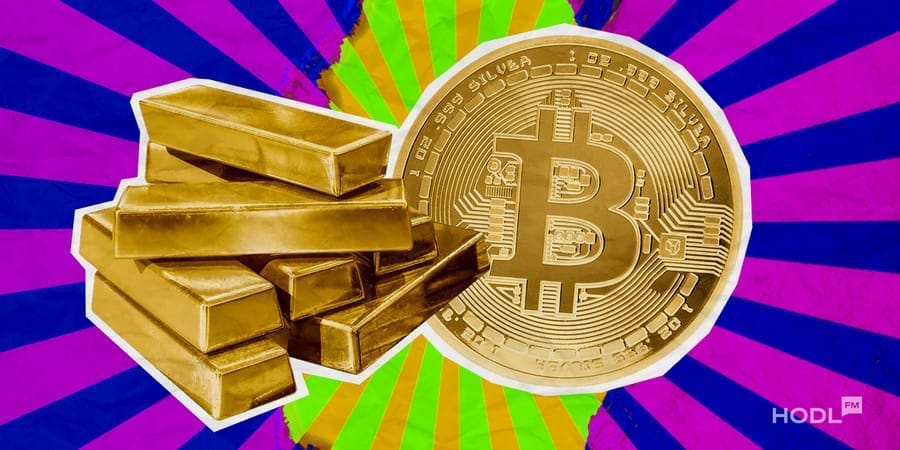
The divergence between gold and digital assets highlighted a central fault line in modern markets. Gold gained more than 83% year over year. Bitcoin fell about 17% over the same period, based on TradingView data.
Daniel Ghali, strategist at TD Securities, told the Wall Street Journal that the rally reflected questions of trust within the global financial system. Trust had weakened but not collapsed, he said, while warning that a full break could extend the move further.
With a US budget deadline set for January 31 and shutdown probabilities rising on Kalshi markets, investors now face a compressed window of political and monetary risk. Markets across asset classes reflect the strain.
Gold’s record may stand as a milestone not just for prices, but for confidence itself.
 Gunel Ismayilova
Disclaimer: All materials on this site are for informational purposes only. None of the material should be interpreted as investment advice. Please note that despite the nature of much of the material created and hosted on this website, HODL FM is not a financial reference resource, and the opinions of authors and other contributors are their own and should not be taken as financial advice. If you require advice. HODL FM strongly recommends contacting a qualified industry professional.