



A new paper released by the Federal Reserve suggests that prediction market platform Kalshi may offer policymakers a more direct and real-time view of macroeconomic expectations than traditional tools. The research, titled Kalshi and the Rise of Macro Markets, evaluates the accuracy and responsiveness of Kalshi’s contracts compared with standard surveys and financial derivatives.
“Managing expectations is central to modern macroeconomic policy. Yet the tools that are often relied upon — surveys and financial derivatives — have many drawbacks,” the paper states.
Researchers Anthony Diercks, Jared Dean Katz, and Jonathan Wright argue that Kalshi captures market beliefs continuously, providing a high-frequency, distributionally rich benchmark useful to both researchers and policymakers.
The Federal Reserve just put out an incredible paper about Kalshi's data.
— Tarek Mansour (@mansourtarek_) February 18, 2026
"Our results suggest that Kalshi markets provide a high-frequency, continuously updated, distributionally rich benchmark that is valuable to both researchers and policymakers."https://t.co/cw5GrDFse6
Kalshi’s approach to measuring expectations
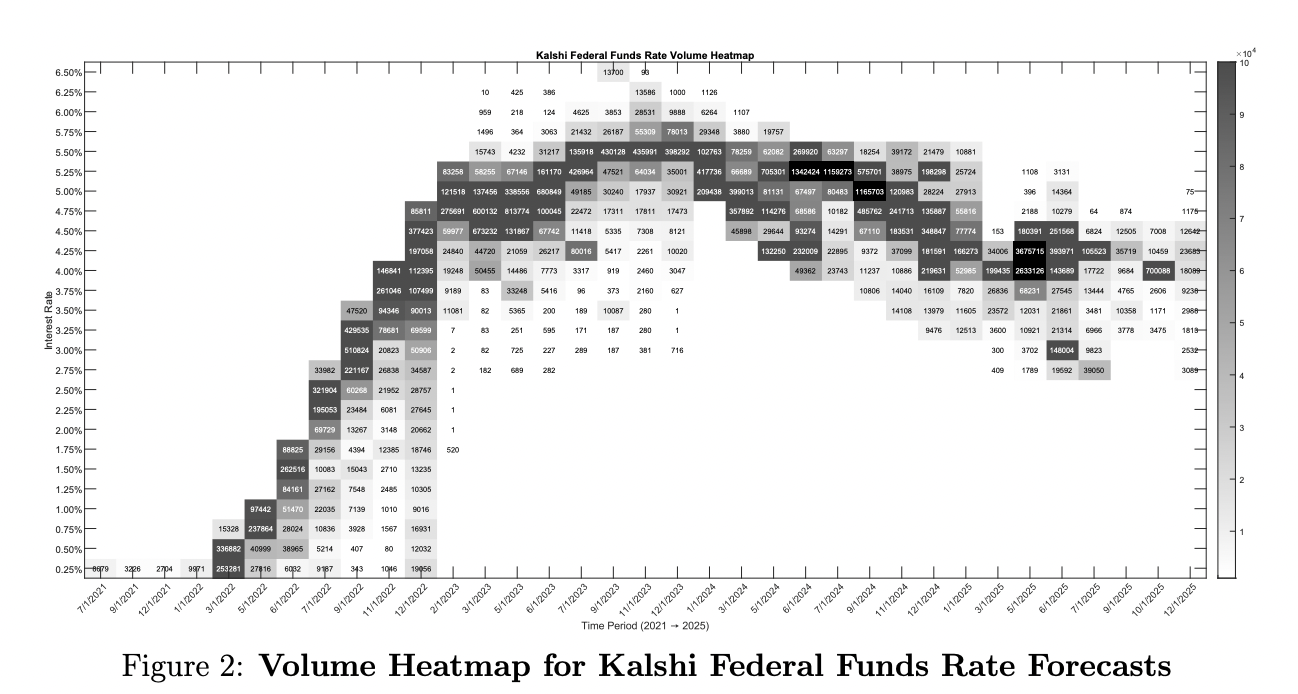
Kalshi allows users to trade contracts tied to macroeconomic outcomes such as consumer price index (CPI) movements, payroll data, GDP growth, and Federal Open Market Committee (FOMC) rate decisions. Each contract reflects the market’s probability that a specific outcome will occur. These probabilities adjust throughout the trading day in response to new data or statements from policymakers.
The researchers highlight a recent example: the implied probability of a July interest rate cut rose to 25 percent after comments from Federal Reserve Governors Christopher Waller and Michelle Bowman. The probability later fell following stronger-than-expected employment data. Such rapid adjustments demonstrate how prediction markets can react faster than surveys, which are often slow to release results, and market-derived measures, which may be complex or less directly tied to policy decisions.
“For the federal funds rate forecasts 150 days ahead, Kalshi’s mean absolute error is very similar to that of professional forecasters. But unlike the survey—which provides a snapshot every six weeks of a modal path—Kalshi offers a continuously updating full distribution,” the authors wrote.
Implications for policy and markets
The paper suggests that Kalshi data could be used to construct risk-neutral probability density models, estimating potential interest rate outcomes for upcoming FOMC meetings. Researchers argue that such models may provide a closer link between market expectations and monetary policy decisions, enhancing the clarity of policy signals.
Prediction markets have become a major trend in financial technology. Platforms such as Kalshi and Polymarket now exceed $10 billion in monthly trading volumes. While Kalshi operates under U.S. regulation via the Commodities Futures Trading Commission (CFTC), some competitors remain in legal gray areas. The paper emphasizes that Kalshi’s regulatory approval makes it a particularly valuable source of data for institutional and policy users.
Greater recognition of prediction markets could encourage broader institutional participation, potentially improving liquidity across both traditional and crypto-based markets. For crypto markets specifically, better regulatory clarity and acceptance of market-based data may support stronger institutional engagement and long-term stability.
Accuracy and early challenges
The research notes that Kalshi predictions are close in accuracy to professional forecasts. The platform has seen isolated cases of market manipulation or volatility linked to incentives and derivative pairs, yet overall performance demonstrates reliable signal generation. By contrast, other platforms have experimented with short-term prediction products, such as 5-minute or 15-minute Bitcoin pairs, which show different liquidity patterns.
“The probabilities respond sharply and sensibly to major developments,” the researchers said. “Kalshi provides the fastest-updating distributions currently available for many key macroeconomic indicators.”
Although the paper does not signal immediate changes in Federal Reserve policy, it highlights a growing interest in incorporating high-frequency, market-based data into macroeconomic analysis. If prediction markets gain wider adoption in policymaking, they may help reduce market volatility and provide clearer expectations for both traditional and crypto investors.
Risk factors and limitations
While Kalshi provides timely insights, the platform carries financial and operational risks that users and policymakers should understand. Prediction markets can be influenced by manipulation. Some markets have experienced volatility due to liquidity incentives, derivative product launches, or targeted copy-trading strategies on platforms such as Polymarket. These events can temporarily distort probabilities and reduce reliability.
Volatility itself represents a key risk. Prices and implied probabilities on prediction markets can swing sharply following unexpected news or policy statements, which may overstate the likelihood of events in the short term. Markets with lower liquidity are especially vulnerable to abrupt moves that do not reflect broader expectations.
 Gunel Ismayilova
Disclaimer: All materials on this site are for informational purposes only. None of the material should be interpreted as investment advice. Please note that, despite the nature of much of the material created and hosted on this website, HODL FM operates as a media and informational platform, not a provider of financial advisory services. The opinions of authors and other contributors are their own and should not be taken as financial advice. If you require advice, HODL FM strongly recommends contacting a qualified industry professional.