



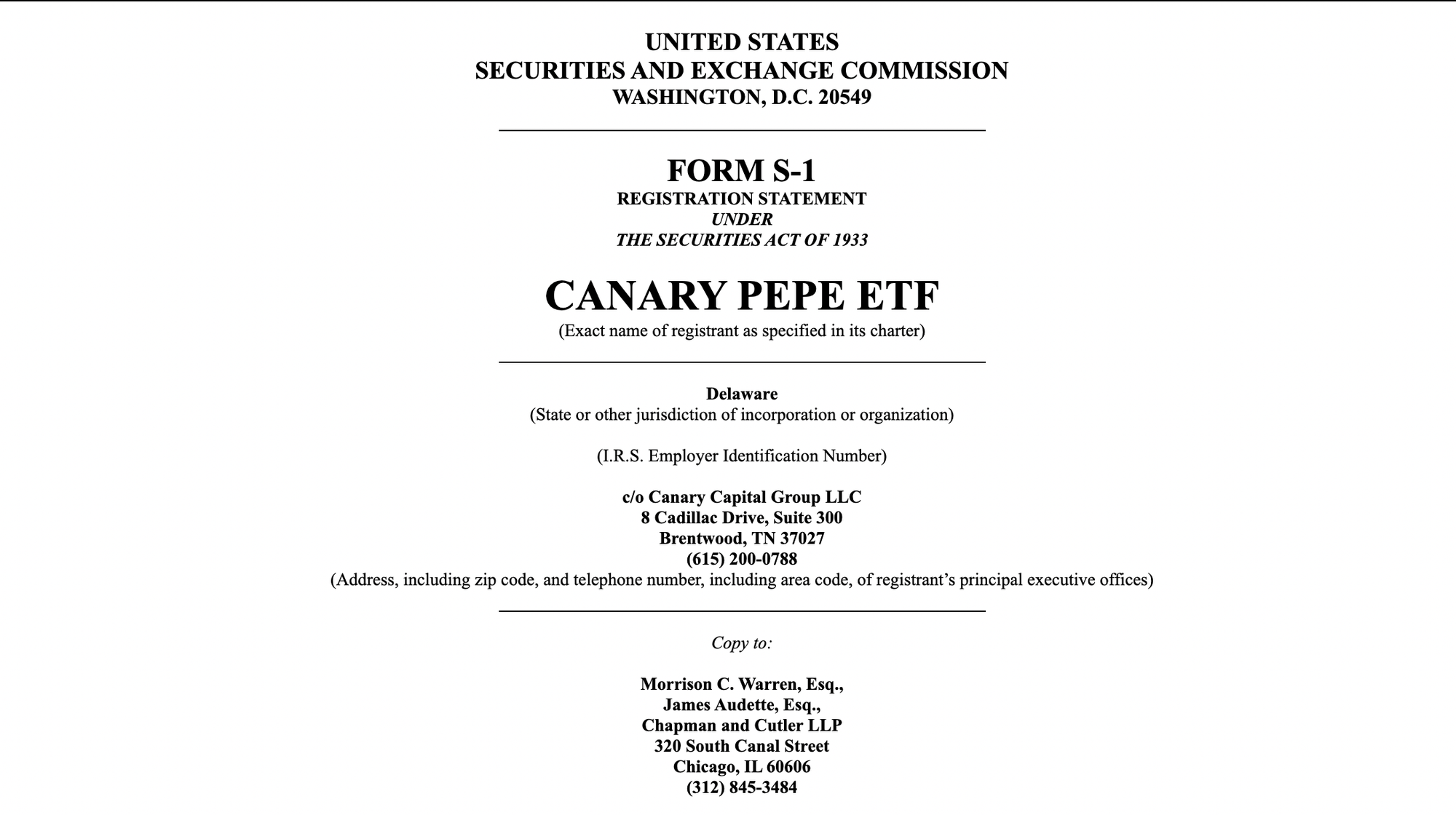
Canary Capital Group LLC submitted a registration statement with the U.S. Securities and Exchange Commission (SEC) on April 8 to introduce a proposed exchange traded fund tied to the meme cryptocurrency PEPE. The filing outlines the structure and vision for the Canary PEPE ETF, formally known as the Trust, which aims to reflect the market price of the PEPE token through a traditional brokerage channel rather than direct token ownership by investors.
The document shows that the Trust’s main objective is to offer exposure to PEPE holdings after subtracting operational costs and other liabilities. The product is designed to allow investors to access the PEPE market without navigating crypto wallets or direct token custody.
“The Trust provides investors with the opportunity to access the market for PEPE through a traditional brokerage account without the potential barriers to entry or risks involved with acquiring and holding PEPE directly,” the filing states.
Financial securities of this sort have precedent in U.S. markets. A separate Grayscale product tied to Dogecoin trades on NYSE Arca, and other crypto-linked products have entered SEC filings in recent years.
Trust structure and asset composition
The proposed ETF would be an exchange traded product that issues shares of beneficial interest. These shares would trade on a public exchange, with the Trust holding PEPE tokens directly as its core asset and a custodial partner responsible for safeguarding the holdings. The Trust will avoid derivatives that could introduce added counterparty and credit exposure.
The Trust intends to value its PEPE holdings at 4:00 p.m. Eastern time daily, based on a benchmark that reflects major trading sources for the token. Custody arrangements would ensure that all PEPE owned by the Trust resides with the designated custodian.
A portion of the fund’s assets, capped at five percent, will initially remain in Ethereum (ETH). This ETH reserve serves a clear purpose: cover network transaction fees required when moving PEPE on the Ethereum blockchain. Over time, ongoing fees and operational expenses will likely lower the Trust’s net PEPE holdings, which may prevent the product from fully achieving its investment objective if these costs reduce asset levels significantly.
Risks and volatility highlighted in filing
The registration statement highlights a range of risks that investors should understand before considering the proposed ETF. PEPE falls within the highly speculative category of digital assets. Unlike Bitcoin, which has broad use as an exchange medium and a long trading history, PEPE’s demand depends heavily on social sentiment and online community dynamics.
“Unlike other digital assets such as bitcoin, the value of PEPE is not primarily related to its utility as a means of transaction and its acceptance in the retail sector is limited,” the filing states.
It adds that the total value of PEPE in circulation remains much smaller than Bitcoin’s and may face competitive pressure from newer digital assets.
The document also mentions limited historical price data for PEPE and possible manipulation in spot markets that lack robust regulation. The Ethereum network itself might pose risks due to transaction congestion or systemic issues that could delay token movement.
Market trends and broader ETF interest
Meme coins have drawn attention from crypto enthusiasts and traditional markets alike. PEPE achieved rapid popularity on social media platforms and crypto forums in 2024. However, Coingecko data shows that the token’s price dropped sharply from the record levels reached in late 2024.
As of January 2026, the filing warned that ownership of PEPE remains concentrated. The ten largest wallets hold an estimated 41 percent of all circulating supply, a condition that could intensify price swings if large holders move tokens in or out of the market.
Other asset managers also explore niche crypto ETF products. Grayscale’s Dogecoin-linked product began trading in late 2025. Tuttle Capital submitted filings tied to the memecoin BONK and other thematic leveraged crypto products. These developments show a broader push to embed digital assets into regulated investment vehicles.
SEC filings on these products highlight that regulated products may attract new sources of capital. But they also emphasize that volatility, liquidity concerns, and concentrated token distribution present challenges to investor protection.
What the filing means for investors
The Canary PEPE ETF proposal may appeal to traders who seek regulated exposure to meme tokens through standard brokerage accounts. Yet it makes clear that potential investors could lose their full investment. The document stresses both the speculative nature of meme tokens and the regulatory uncertainty surrounding their trade and custody.
As the crypto market evolves and more firms file for niche products, regulators and market participants will assess how these products perform relative to established benchmarks and investor expectations.
 Gunel Ismayilova
Disclaimer: All materials on this site are for informational purposes only. None of the material should be interpreted as investment advice. Please note that, despite the nature of much of the material created and hosted on this website, HODL FM operates as a media and informational platform, not a provider of financial advisory services. The opinions of authors and other contributors are their own and should not be taken as financial advice. If you require advice, HODL FM strongly recommends contacting a qualified industry professional.