




The cryptocurrency market faced renewed pressure on Wednesday and Thursday after the Federal Reserve kept interest rates unchanged and geopolitical tensions disrupted global energy markets. Bitcoin hovered near a critical level as traders reacted to inflation signals, policy uncertainty, and a sharp rise in oil prices.
Fed keeps rates steady as inflation concerns persist
The Federal Reserve maintained its benchmark interest rate within a 3.50% to 3.75% range, which is the second consecutive meeting without a change. The decision extended a pause that followed rate cuts last year.
In its statement, the Federal Open Market Committee noted that “inflation remains somewhat elevated” while job growth has slowed. The unemployment rate rose to 4.4% in February, which added another layer of uncertainty to the outlook.
Jerome Powell addressed the situation during a press conference. He said,
“Near term measures of inflation expectations have risen in recent weeks, likely reflecting the substantial rise in oil prices caused by the supply disruptions in the Middle East.”
He added that it is “too soon to know” the full economic impact of the conflict.
Powell also pointed to tariffs as a contributing factor to price pressures. He said, “some big chunk of that, between a half and three-quarters, is actually tariffs.” He emphasized that central bank independence remains essential, stating,
“Independence is what allows us to do our jobs, and stable prices is half of our mandate, it’s one of our two mandates – maximum employment being the other.”
Bitcoin struggles near key support
Bitcoin fell sharply after the Fed decision and broader macro developments. The asset dropped from recent highs near $75,000–$76,000 and traded around $70,000–$71,000 during the latest session. Data from CoinGecko showed a decline of roughly 5% within 24 hours.
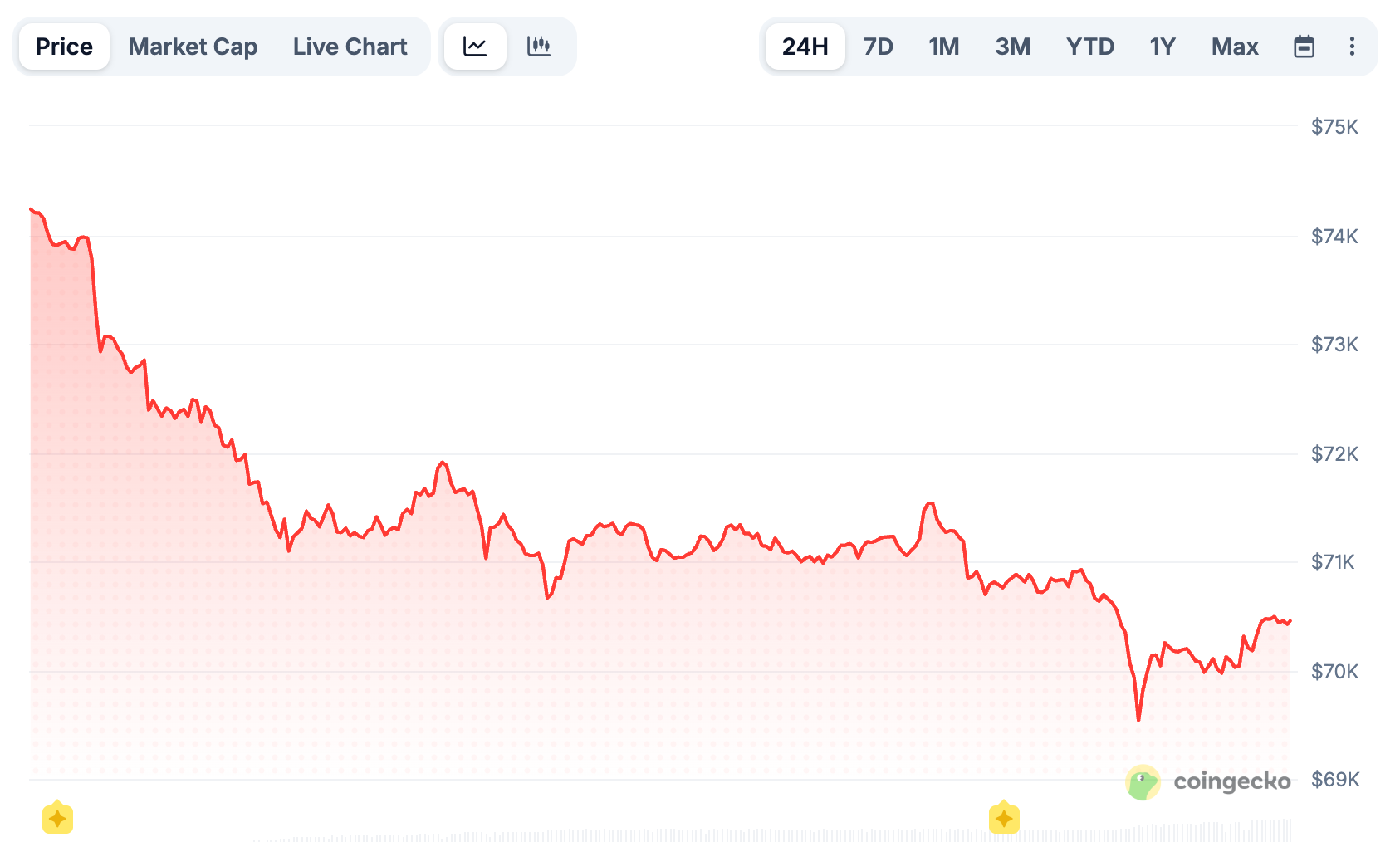
The pullback placed Bitcoin close to a key psychological level at $70,000. In recent sessions, this range has been viewed as a support zone.
Other major digital assets followed a similar path. Ethereum lost around 6%, while Solana, BNB, and Dogecoin recorded losses between 3% and 6%. Smaller tokens such as Zcash and Worldcoin saw steeper declines above 10%.
CoinMarketCap data shows the total value of all cryptocurrencies dropped to about $2.42 trillion, which is a sign that people are selling off risky assets.
Energy conflict shakes global markets
The downturn coincided with escalating conflict in the Middle East. BBC report confirmed that Israel struck Iran’s South Pars gas field, a major energy facility that supplies a large portion of the country’s domestic gas.
The attack intensified an ongoing confrontation involving the U.S., Israel, and Iran. It also contributed to disruptions in the Strait of Hormuz, a key route for global oil shipments.
Oil prices reacted immediately. Brent crude rose as high as $113 per barrel during Thursday trading. The surge reflected concerns over prolonged supply disruptions.
Financial markets moved in tandem with crypto. Major equity indices such as the Dow Jones Industrial Average, Nasdaq 100, and S&P 500 posted declines. Asian markets, including Japan’s Nikkei 225 and Hong Kong’s Hang Seng, also dropped more than 2%.
Precious metals did not provide a hedge. Gold fell 2.1% and silver dropped 3.5%, erasing about $150 billion in combined value. The parallel decline in both crypto and gold pointed to a shift toward cash positions rather than rotation between alternative assets.
Inflation data and liquidations deepen losses
Economic data added further pressure. The latest Producer Price Index showed higher-than-expected wholesale inflation, with core PPI at 3.9% and headline PPI at 3.4%. The data reinforced expectations that interest rates may remain elevated for longer.
Markets adjusted quickly. Expectations for near-term rate cuts weakened after Powell reiterated a data-dependent approach.
The shift triggered a wave of liquidations across leveraged crypto positions. Data from CoinGlass showed that more than $593 million in positions were wiped out within 24 hours. Bitcoin accounted for over $222 million in liquidations, while Ethereum followed with more than $179 million.
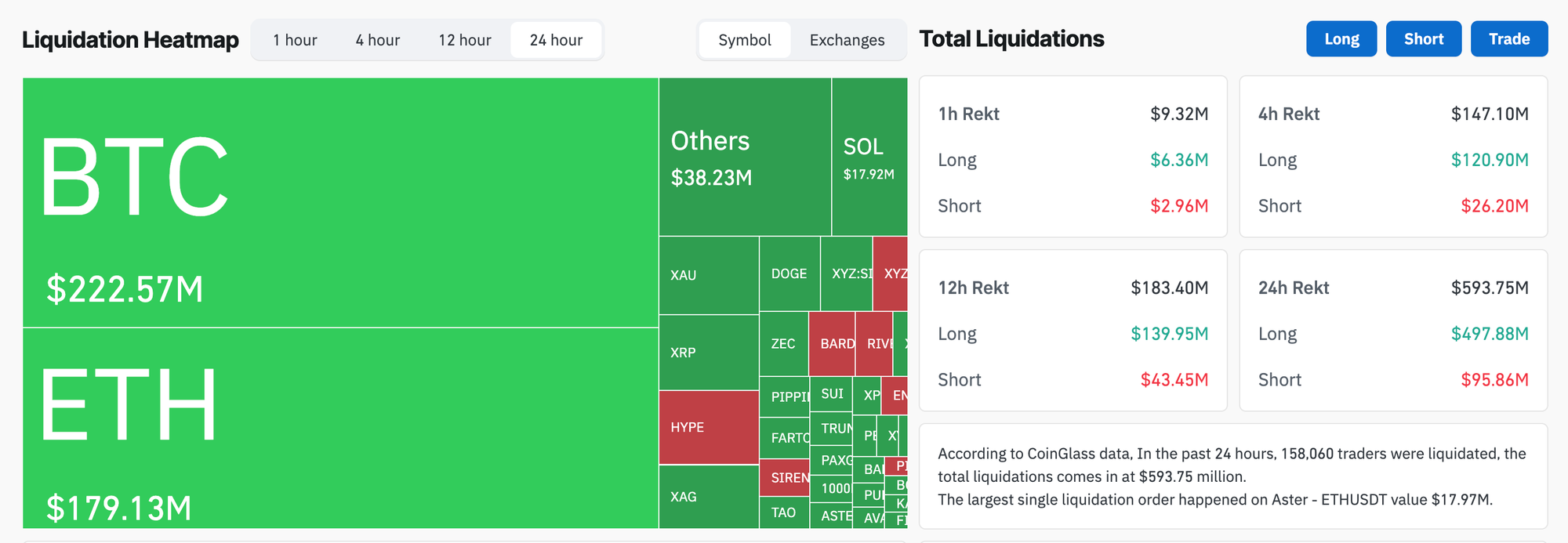
Long positions suffered the largest losses. These trades depend on rising prices, and forced closures occur when margin thresholds break.
Institutional flows show mixed signals
Despite short-term volatility, institutional demand has not disappeared. SoSoValue data shows U.S.-listed spot Bitcoin ETFs recorded about $1.16 billion in inflows over seven consecutive sessions before Wednesday. That trend ended with a daily outflow of around $129 million as prices declined.
The data showed a divergence between long-term positioning and short-term reactions. ETF flow reports reflect end-of-day activity and do not capture intraday shifts, yet the earlier streak indicated sustained interest.
Outlook remains uncertain
Bitcoin now faces a narrow range between support near $70,000 and resistance above $72,500. A break below support could open the path toward $65,000 or lower levels, while a move above resistance may restore momentum toward recent highs.
The macro backdrop continues to dominate price action. Elevated inflation, rising energy costs, and geopolitical risks have shaped investor behavior across asset classes.
As HodlFm reported in January, Powell's tenure as Fed Chair is scheduled to end in May, and if confirmed, former governor Kevin Warsh is anticipated to take over. Powell stated,
“I have no intention of leaving the board until the investigation is well and truly over, with transparency and finality.”
For now, markets remain sensitive to incoming data and developments in the Middle East. Bitcoin holds above $70,000, but pressure persists across both crypto and traditional financial markets.
 Gunel Ismayilova
Disclaimer: All materials on this site are for informational purposes only. None of the material should be interpreted as investment advice. Please note that, despite the nature of much of the material created and hosted on this website, HODL FM operates as a media and informational platform, not a provider of financial advisory services. The opinions of authors and other contributors are their own and should not be taken as financial advice. If you require advice, HODL FM strongly recommends contacting a qualified industry professional.