

Bitcoin’s use and acceptance continued to expand in 2025, even as its market price declined sharply from last year’s peak, according to the financial services firm River.
The report, published Tuesday, points to a steady rise in Bitcoin adoption across financial institutions, banks, merchants, public companies, and even governments.
That momentum has continued despite a sharp pullback in price.
Bitcoin is trading about 50% below its October peak of $66,077, yet River’s data suggests adoption is moving on a separate track from the market cycle.
In the report’s words, it is:
“Trust in Bitcoin has grown faster than that of any asset in history,”
Institutions, banks, and public companies increase holdings
River found that institutions acquired 829,000 BTC in 2025, including purchases by businesses, governments, investment funds, and ETFs. Registered investment advisors have consistently added to their Bitcoin holdings for eight consecutive quarters, investing around $1.5 billion in Bitcoin ETFs per quarter over the last two years.
“These institutions represent millions of underlying individuals gaining exposure to Bitcoin for the first time through brokerage accounts, retirement plans, sovereign funds, and corporate balance sheets,” the report said.
Approximately 60% of the largest U.S. banks are developing Bitcoin products.
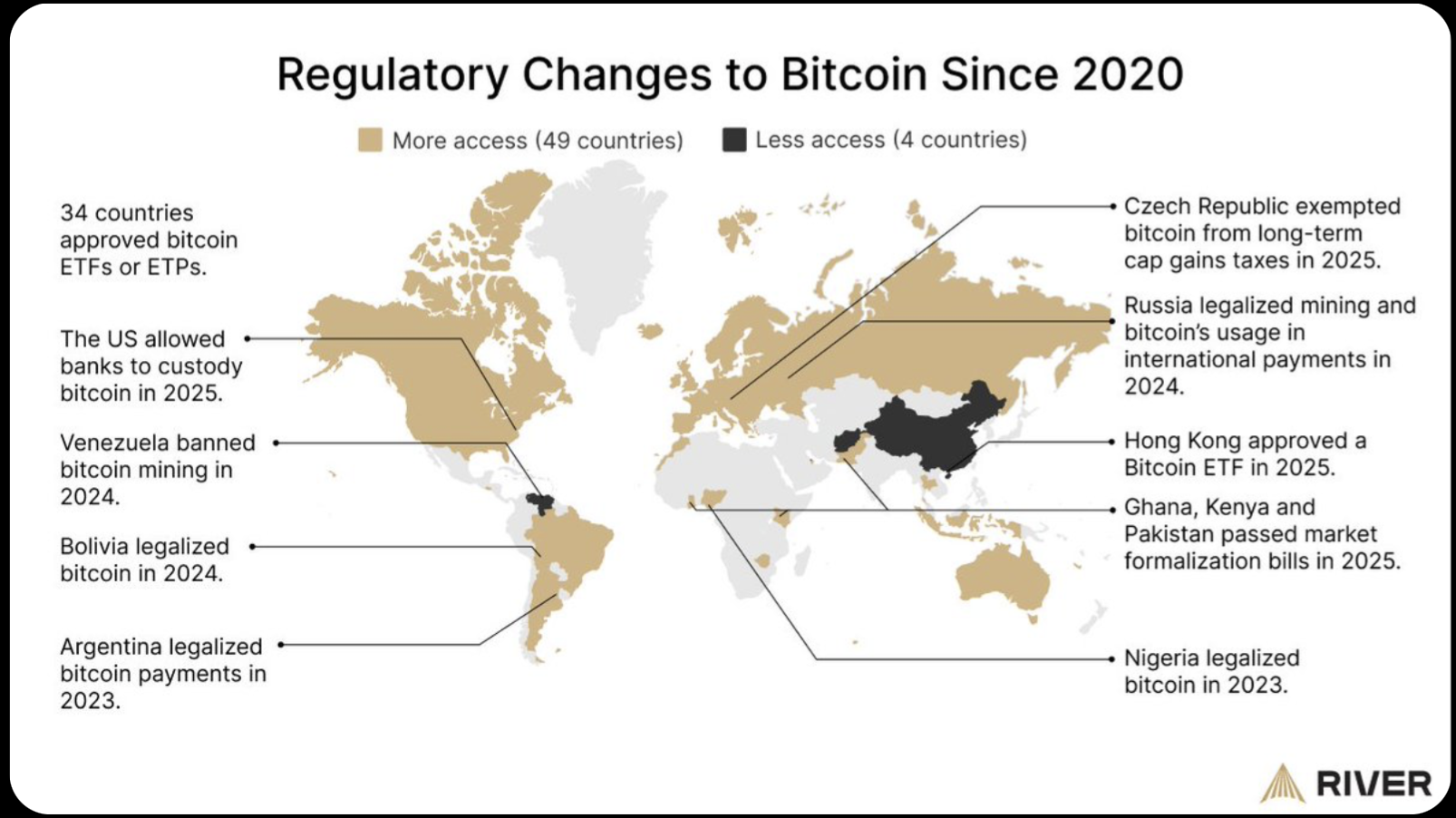
With a favorable regulatory environment, banks can now offer Bitcoin custody and other services to customers.
Corporate adoption was particularly strong. Businesses accounted for the largest portion of Bitcoin purchases in 2025, with crypto treasury firms leading the expansion.
Their adoption grew 2.5 times year over year.
Merchant adoption and payment networks expand
Merchant adoption accelerated in 2025, with the number of U.S. businesses accepting Bitcoin tripling and global adoption increasing 74%. Bitcoin payments through the Lightning Network grew 300% over the year, and River estimates the network now processes over $1.1 billion in monthly transaction volume.
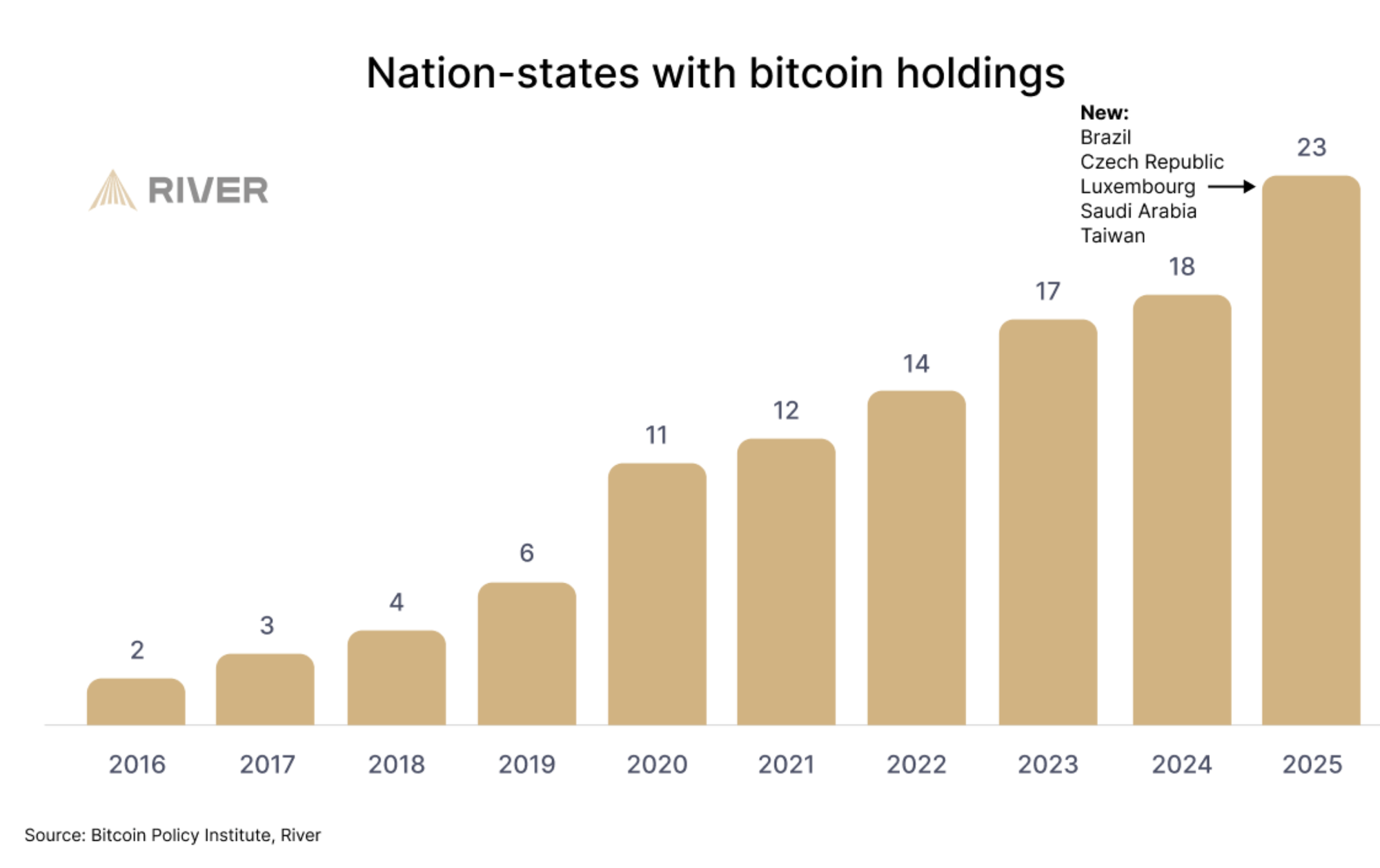
Five nation-states added Bitcoin to their holdings in 2025.
Purchases came from two sovereign wealth funds in Luxembourg and Saudi Arabia, one central bank in the Czech Republic, and additional acquisitions by Brazil and Taiwan.
“What began as an experiment is now a globally recognized store of value, with adoption patterns that rival the internet.”
River estimates that 23 countries now hold Bitcoin through mining operations, seizures, or central bank exposure.
Volatility declines, signaling maturity
Bitcoin’s price volatility is falling, approaching levels seen in gold and the S&P 500. River interprets this trend as evidence that the cryptocurrency is increasingly regarded as a mature asset class.
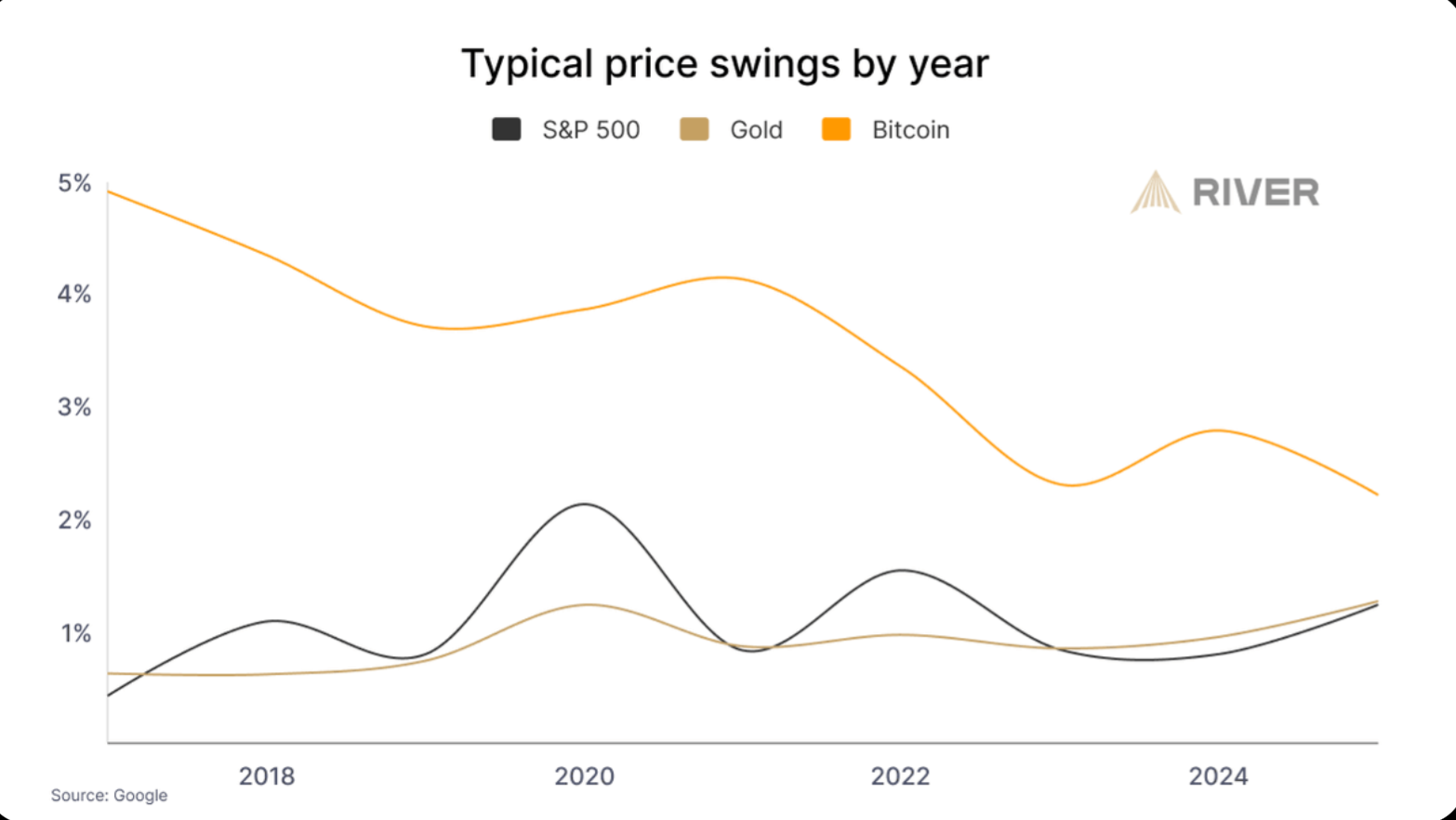
Lower volatility reduces the barriers for risk-averse investors, potentially opening access to larger pools of capital.
They emphasized Bitcoin’s unique attributes.
The report described it as the world’s “only scarce and incorruptible form of digital money,” projecting that adoption will not only continue but accelerate in the coming years.
Looking ahead to 2026
If the past year offered a glimpse of where adoption is heading, the next phase may be defined less by speculation and more by integration into existing financial systems.
New financial products, custody services, treasury allocations, and payment infrastructure tend to develop gradually, often outside the daily movements of the market. As more banks integrate Bitcoin services and institutional investors gain exposure through regulated products, access widens across traditional financial channels. Merchant acceptance is also increasing, particularly as payment rails such as the Lightning Network mature and transaction costs fall.
River’s report frames this trend as a shift in how Bitcoin is being used and understood globally.
What started as an experimental digital currency now sits inside brokerage platforms, corporate balance sheets, and, increasingly, government portfolios.
 Anastasiia G
Disclaimer: All materials on this site are for informational purposes only. None of the material should be interpreted as investment advice. Please note that, despite the nature of much of the material created and hosted on this website, HODL FM operates as a media and informational platform, not a provider of financial advisory services. The opinions of authors and other contributors are their own and should not be taken as financial advice. If you require advice, HODL FM strongly recommends contacting a qualified industry professional.