

Stablecoin reserves on Binance have dropped sharply in recent months. The decline points to continued liquidity pressure across crypto markets and comes as a politically linked stablecoin project experienced its own volatility.
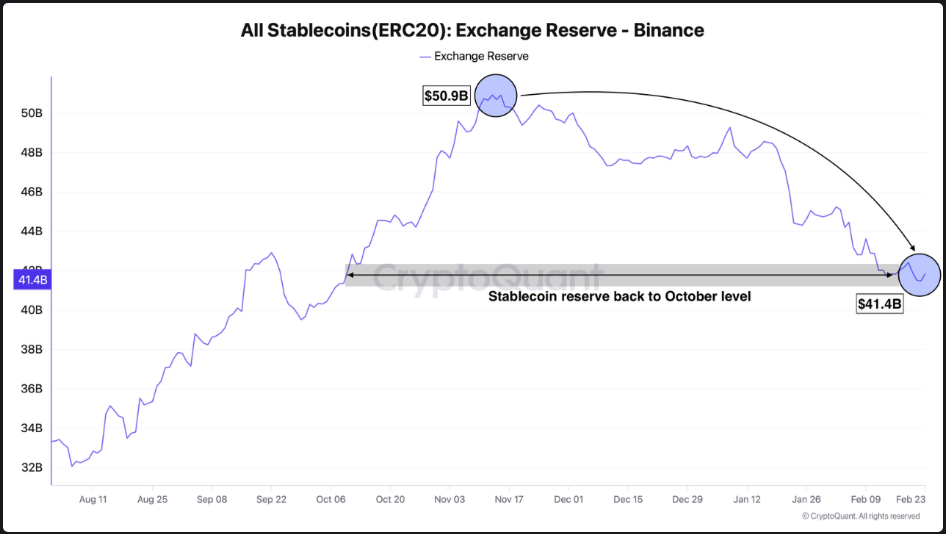
Data from CryptoQuant shows reserves on the exchange have fallen about 18.6% since November, declining by roughly $10 billion from $50.9 billion to about $41.4 billion. According to analyst Darkfost, movements in exchange stablecoin balances often reflect shifts in investor demand and broader market liquidity.
Despite the decline, Binance still holds roughly 64% of all stablecoin reserves across crypto exchanges.
Analysts note that changes at a platform of that size tend to attract attention because they may signal shifts in market behavior rather than isolated flows.
Liquidity headwinds continue across markets
A reduction in stablecoin balances on exchanges typically indicates that investors are withdrawing liquidity from crypto markets, converting funds back into fiat instead of leaving capital parked in stablecoins for potential redeployment.
CryptoQuant analysts say the current environment is shaped largely by a lack of incoming capital. From a broader liquidity perspective across financial markets, conditions may remain tight in the near term.
“One of the key headwinds currently weighing on the space is the lack of incoming liquidity,” commented Darkfost, who cautioned that “from a broader cross-market liquidity perspective, conditions are unlikely to improve in the near term.”
The wider stablecoin sector has also slowed.
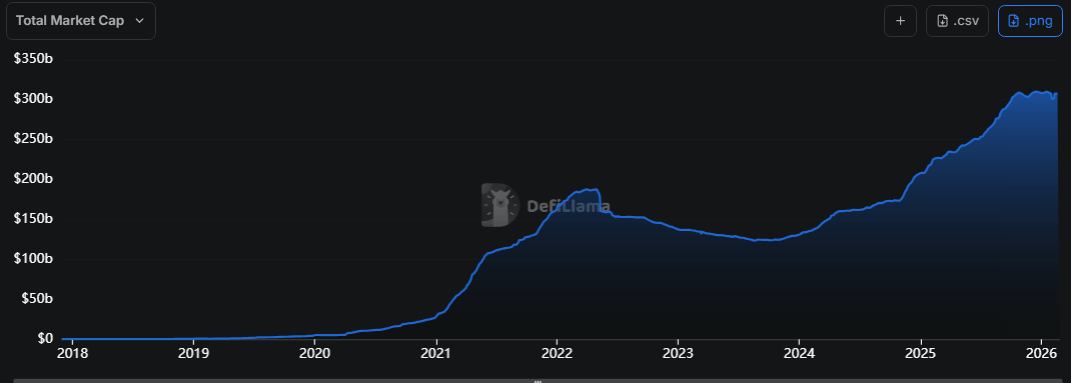
Total stablecoin market capitalization has held just above $300 billion since October, according to DeFiLlama, following two years of expansion that pushed circulation up roughly 150%.
The last sustained contraction occurred during the 2022 bear market that followed the Terra-Luna collapse, with the sector not recovering until late 2023.
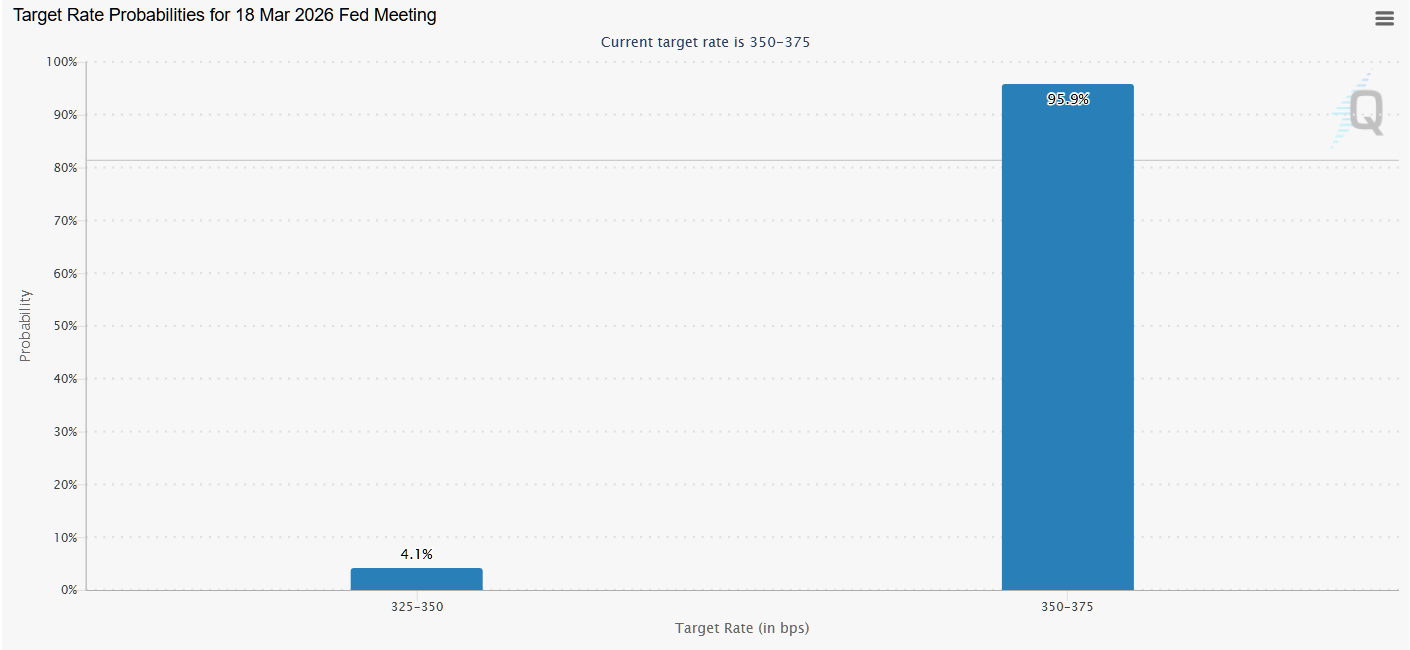
Monetary policy remains another factor influencing liquidity conditions. Federal Reserve Governor Christopher Waller said he would support keeping interest rates unchanged at the March meeting if labor market data suggests the economy is stabilizing.
Futures markets tracked by CME currently place a high probability on rates remaining on hold.
Stablecoin volatility hits Trump-linked project
At the same time liquidity concerns persist, a separate episode drew attention to the stability of a newer stablecoin tied to a politically connected crypto venture.
World Liberty Financial said it had been targeted by hackers, short sellers and what it described as coordinated social media activity aimed at creating disruption around its USD1 stablecoin and WLFI token.
A coordinated attack was launched against USD1 this morning. Attackers hacked several WLFI cofounder accounts, paid influencers to spread FUD, and opened massive $WLFI shorts to profit from the manufactured chaos.
— WLFI (@worldlibertyfi) February 23, 2026
It didn’t work.
Thanks to USD1’s sound mint-and-redeem mechanism…
WLFI Official Statement.
According to the company, attackers compromised several co-founder accounts, opened large short positions and encouraged negative commentary online. The WLFI token fell roughly 7% during the incident before stabilizing, while USD1 briefly slipped to about $0.994 before returning close to its dollar peg.
The firm said the stablecoin’s mint-and-redeem mechanism and full backing allowed it to recover quickly.
World Liberty Financial is linked to US President Donald Trump and his sons, and the episode occurred shortly after a crypto forum held at the Trump family’s Mar-a-Lago resort that included industry and government figures. Former Binance CEO Changpeng Zhao also attended the event.
Questions over ties and stablecoin exposure
The incident has also revived scrutiny of connections between World Liberty and Binance entities. Reports from Bloomberg and The Wall Street Journal have said Binance helped create USD1, while Forbes previously reported that the exchange held a large share of the stablecoin supply in circulation.
Lawmakers in the United States have raised questions about those relationships following Trump’s pardon of Zhao in 2025. Zhao has said there are no business ties between him and the Trump family and that he does not intend to return to lead Binance.
USD1 has also been used in major transactions tied to the exchange ecosystem, including the settlement of a multibillion-dollar investment involving UAE-based firm MGX, which has drawn additional attention to potential conflicts of interest involving the project.
 Gunel Ismayilova
Disclaimer: All materials on this site are for informational purposes only. None of the material should be interpreted as investment advice. Please note that, despite the nature of much of the material created and hosted on this website, HODL FM operates as a media and informational platform, not a provider of financial advisory services. The opinions of authors and other contributors are their own and should not be taken as financial advice. If you require advice, HODL FM strongly recommends contacting a qualified industry professional.