




Vitalik Buterin has expanded on a development roadmap aimed at making Ethereum faster and more resilient to future cryptographic threats.
The roadmap, referred to internally as the "Strawmap", focuses on reducing the time it takes to produce new blocks and confirm transactions while preparing the network for post-quantum cryptography in the coming years.
"The goal is to decouple slots and finality, to allow us to reason about both separately," Buterin said.
Faster block times under discussion
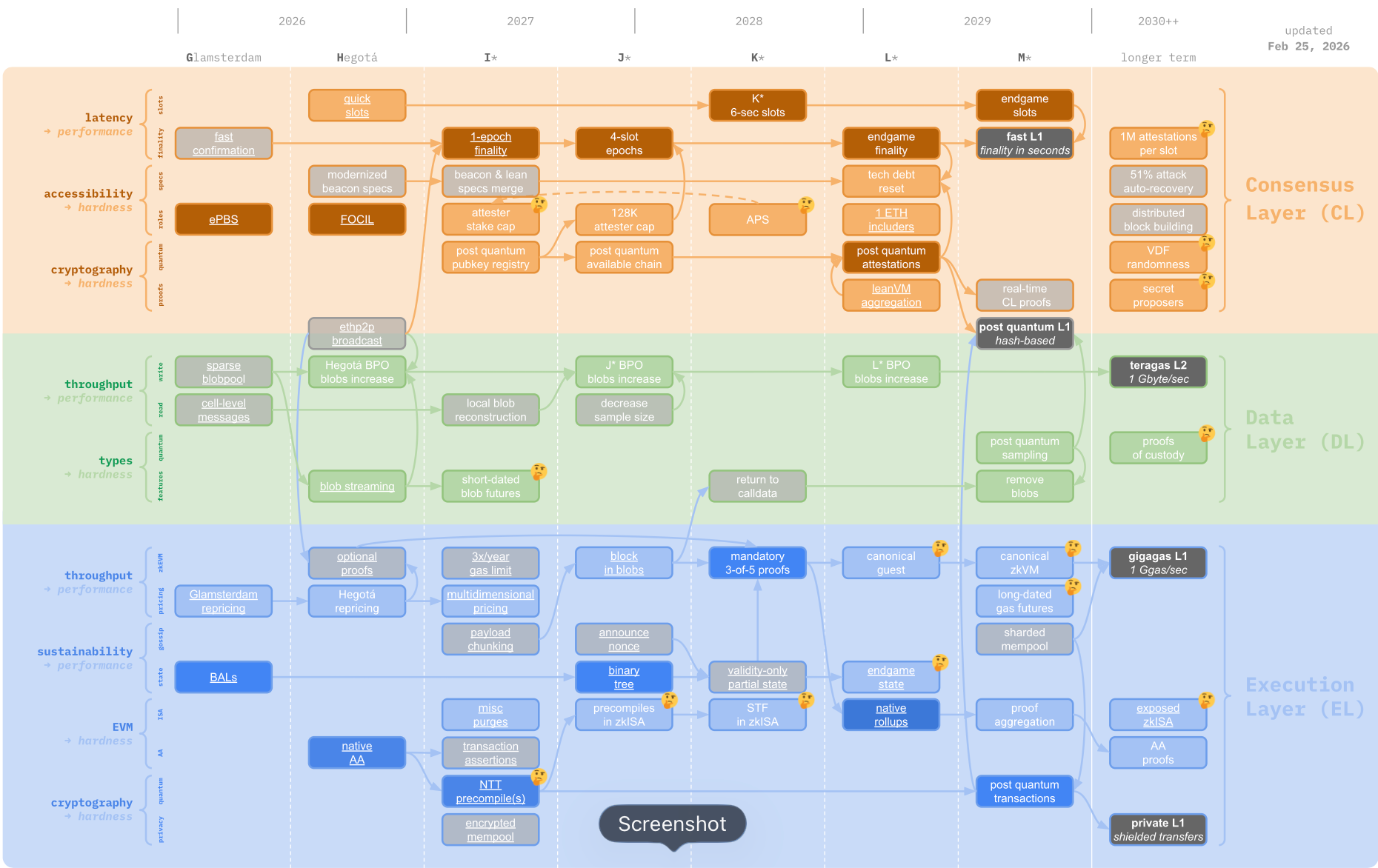
The outline builds on a recently published visual roadmap from the Ethereum Foundationprotocol team. Ethereum currently produces blocks about every 12 seconds. Developers are examining a gradual reduction in that interval to improve network responsiveness.
The progression discussed includes intermediate reductions before potentially reaching a target closer to two seconds. Network upgrades to Ethereum’s peer-to-peer layer are also part of the plan.
Improvements in how nodes share blocks and data may reduce propagation delays across the network. According to Buterin, these changes could allow shorter slot times without introducing additional security risks.
"Fast slots are off in their own lane at the top of the roadmap, and do not really seem to connect to anything," he said, adding that much of the remaining roadmap does not depend directly on slot timing.
Finality targeted to fall from minutes to seconds
Another area of work involves finality, the stage at which transactions become irreversible on the network. At present, finality on Ethereum typically takes around 16 minutes.
Developers are exploring changes that could bring that window down to roughly six to sixteen seconds. The proposal includes replacing parts of the current confirmation system with a simplified design that supports post-quantum cryptography.
Buterin described the shift as a significant change to Ethereum’s consensus design.
The “component-by-component replacement” of Ethereum’s slot structure and consensus will produce a “cleaner, simpler, quantum-resistant, prover-friendly, end-to-end formally-verified alternative.”
The largest steps would likely be introduced alongside a transition to new cryptographic systems, including hash-based signatures.
Early quantum protections in the slot system
Buterin said one possible outcome of the staged approach is that parts of the network could adopt quantum-resistant protections earlier than others. In this scenario, slot production could transition before the finality system is fully updated.
He noted that this could allow the blockchain to continue operating even if advanced quantum computers appeared unexpectedly, though some guarantees around finality could temporarily differ during the transition period.
The broader roadmap spans about four years and includes a sequence of network upgrades planned roughly every six months. Two upcoming forks, known as Glamsterdam and Hegotá, are already scheduled for later this year.
Industry discussion around quantum security continues
Preparation for post-quantum cryptography is also appearing in discussions across the broader crypto sector. A recent analysis from CoinShares examined how future quantum computing developments could affect blockchain security, including Bitcoin.
In that report, Christopher Bendiksen, Bitcoin research lead at CoinShares, said cryptographically relevant quantum systems would require a scale of hardware far beyond current machines, pointing to the need for millions of stable qubits before such threats become practical.
Developers across several blockchain projects are studying upgrade paths that would allow networks to introduce post-quantum cryptography gradually if the technology becomes viable.
 Roman Zaika
Disclaimer: All materials on this site are for informational purposes only. None of the material should be interpreted as investment advice. Please note that, despite the nature of much of the material created and hosted on this website, HODL FM operates as a media and informational platform, not a provider of financial advisory services. The opinions of authors and other contributors are their own and should not be taken as financial advice. If you require advice, HODL FM strongly recommends contacting a qualified industry professional.