

Developers working on Ethereum have scheduled a major protocol update known as the Hegotá upgrade, expected in the second half of 2026. The update includes a proposal aimed at strengthening censorship resistance at the protocol level.
The change centers on Fork-Choice Enforced Inclusion Lists, or FOCIL, introduced as EIP-7805. The mechanism is designed to ensure that valid transactions broadcast to the public mempool cannot be ignored by block producers.
Under the proposal, if a specific block fails to include transactions listed for inclusion, the chain can fork away from that block. The design is intended to guarantee that valid public-mempool transactions are included within a limited number of slots.
The change comes after periods where some validators declined to include certain transactions. In particular, activity linked to sanctioned addresses or protocols including the once-sanctioned Tornado Cash highlighted the limits of voluntary inclusion practices on the network.
Developers say FOCIL aims to make inclusion enforceable by the protocol itself rather than dependent on validator behavior.
How the upgrade fits into Ethereum’s roadmap
Hegotá follows earlier upgrades in Ethereum’s development cycle. The previous Fusaka upgrade introduced PeerDAS along with several smaller changes, while the upcoming Glamsterdam upgrade is expected to include block-level access lists and enshrined proposer-builder separation.
Planning for Hegotá began with a proposal window running from early January through early February, followed by developer discussions during All Core Devs calls.
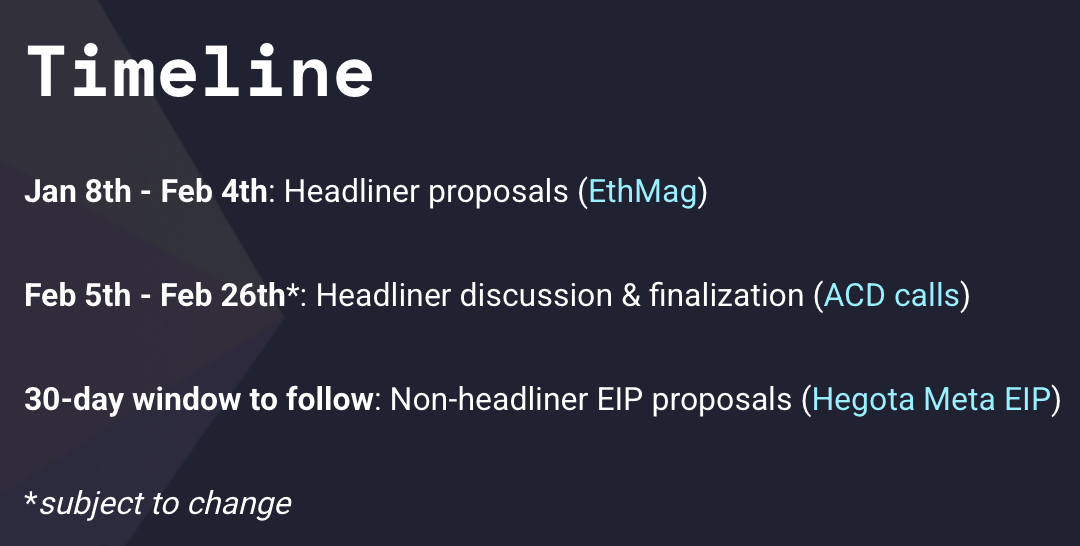
During this phase, proposals are reviewed for technical readiness, user impact, and long-term relevance to the network.
A broader push for censorship resistance
FOCIL is also being discussed alongside other proposals that aim to address transaction censorship and centralization pressures across Ethereum’s transaction pipeline.
One of those is the Universal Enshrined Encrypted Mempool (EIP-8105), which would encrypt transaction details before they are included in a block. Another is enshrined proposer-builder separation, previously selected for inclusion in the Glamsterdam upgrade.
Together, these mechanisms have been described by developers as addressing different points where censorship or transaction filtering can occur in Ethereum’s block-building process.
Recent discussions around these proposals focus on how activity has shifted away from the public mempool. Many transactions now move through private order flow and specialized builders, a trend some developers say increases centralization pressure in the network’s transaction supply chain.
The proposed changes attempt to restore guarantees around transaction inclusion while keeping block production decentralized.
Combining enshrined proposer builder separation, FOCIL and encrypted mempools would shift censorship resistance from a theoretical goal to a protocol-level guarantee.
In practice, that means transactions could be broadcast publicly without revealing their contents before inclusion, while validators would still be required to include valid transactions within a limited number of slots. The approach is also intended to reduce reliance on private order flow and limit front-running risks that have pushed activity away from Ethereum’s public mempool in recent years.
Buterin backs the direction of the upgrade
Vitalik Buterin, Ethereum’s co-founder, publicly supported the direction of the proposal in a post on X.
“FOCIL enables censorship-resistant rapid inclusion of any transaction,” Buterin wrote.
He explained that the mechanism works alongside EIP-8141, which introduces improvements that make smart accounts, including multisig wallets, quantum-resistant signatures, key changes, and gas sponsorship more integrated into the protocol.
According to Buterin, the two proposals together expand how transactions can be included on the network.
“Hence, with FOCIL and 8141 together, anything, including smart wallet txs, gas sponsored txs, and even privacy protocol txs, can be included on-chain through one of 17 different actors (the proposer or the includers) that are all chosen randomly in each slot,” he wrote.
Buterin added that the mechanism is designed to deliver “guaranteed rapid inclusion,” meaning most valid transactions could be included within one to two slots even in difficult network conditions.
“Ethereum is going hard,” he wrote.
In a separate post, Buterin described a broader goal of reinforcing Ethereum’s cypherpunk roots.
“I’m actually trying to do something even more ambitious: Create ‘cypherpunk principled non-ugly Ethereum’ as a bolt-on to the present-day system, in a way that's as tightly integrated and interoperable as possible, and then grow it over time.”
Debate among developers
Not all developers agree on the impact of the proposal.
Ethereum developer Ameen Soleimani warned that forcing inclusion of transactions could introduce unintended consequences for validators and block builders.
“ETH devs, I love you. You mean well. But when you create an EIP to solve the problem of 'filtering out transactions with sanctioned addresses' and your solution is 'to allow validators to impose constraints on builders by force-including transactions in their blocks'... we have a problem, a big problem,” he wrote on X.
The debate reflects a broader discussion across the Ethereum ecosystem about how to balance censorship resistance, validator autonomy, and network efficiency as upgrades move forward.
 Anastasiia G
Disclaimer: All materials on this site are for informational purposes only. None of the material should be interpreted as investment advice. Please note that, despite the nature of much of the material created and hosted on this website, HODL FM operates as a media and informational platform, not a provider of financial advisory services. The opinions of authors and other contributors are their own and should not be taken as financial advice. If you require advice, HODL FM strongly recommends contacting a qualified industry professional.