



The Ethereum Foundation has started staking a portion of its treasury through a simplified distributed validator system known as DVT-lite. The move involves roughly 70,000–72,000 ETH and marks a new phase in how large institutions participate in Ethereum’s proof-of-stake network.
Ethereum co-founder Vitalik Buterin revealed the deployment in a post on X. The system aims to make distributed staking easier to operate for institutions that hold significant amounts of Ether but lack complex validator infrastructure.
"My hope for this project is that in the process, we can make it maximally easy and one-click to do distributed staking for institutions," Buterin wrote.
The Ethereum Foundation is using DVT-lite to stake 72,000 ETH:https://t.co/NIt4mksntj
— vitalik.eth (@VitalikButerin) March 9, 2026
My hope for this project is that in the process, we can make it maximally easy and one-click to do distributed staking for institutions. Choose which computers run your nodes, make a config…
Ethereum Foundation begins treasury staking
The initiative follows the Ethereum Foundation’s treasury policy announced last year. According to the organization, approximately 70,000 ETH from its treasury has entered the staking pipeline. Rewards generated by the validators will return directly to the foundation’s treasury.
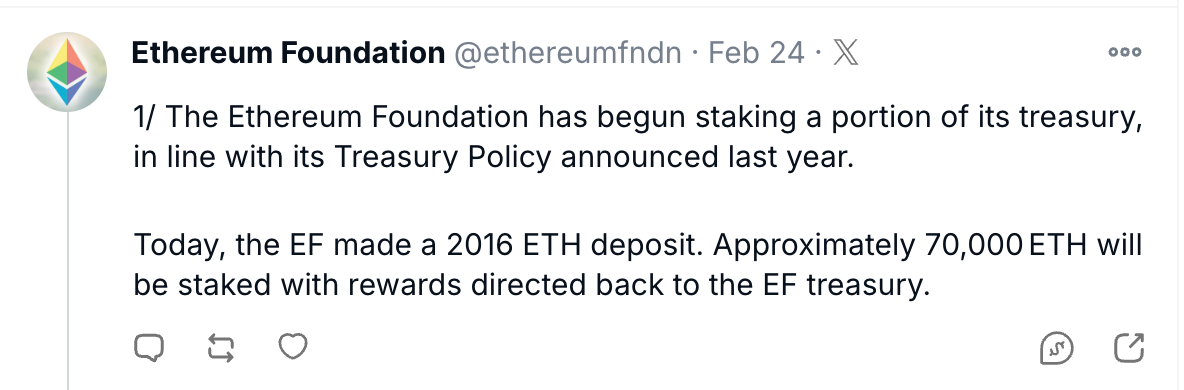
The first deposits have already appeared on-chain. Remaining validator deposits will arrive over the coming weeks as the setup progresses.
The assets currently sit in Ethereum’s validator entry queue and are expected to begin staking around March 19 once activation completes.
By participating directly in consensus, the foundation receives ETH-denominated yield while operating inside Ethereum’s economic framework. The organization also exposes itself to the operational risks and friction that ordinary validators experience, which creates a real-world test for its staking design.
What DVT-lite changes for validator infrastructure
Distributed validator technology allows several machines to operate a validator together rather than relying on a single server. Traditional solo staking runs entirely on one machine. A crash, network outage, or security compromise can lead to downtime or penalties.
Full distributed validator setups solve that problem by splitting the validator key across multiple machines. However, those systems often require complex configuration and coordination between operators.
DVT-lite attempts to remove that complexity.
Instead of splitting the key, the system allows several nodes to use the same validator key. If one machine stops functioning, another node in the cluster continues the validator operation. The design reduces downtime risks while keeping deployment relatively simple.
Buterin described how the process should work once simplified infrastructure becomes widely available.
"Choose which computers run your nodes, make a config file where they all have the same key, and then from there everything gets set up automatically."
One-click staking vision for institutions
The broader goal focuses on accessibility rather than purely technical performance. Many institutions hold large amounts of Ether but avoid direct staking due to operational complexity.
Buterin argued that blockchain infrastructure should not require professional-level expertise.
"The idea that 'running infrastructure' is this scary complicated thing where each person participating must be a 'professional' is awful and anti-decentralization, and we must attack it directly."
In his vision, node deployment should resemble launching a containerized application.
"It should be a docker container or nix image or similar, one click or command line per node, enter the same key in each node, and they automatically find each other, the networking is set up, the DKG happens, and the staking begins."
The Ethereum Foundation implemented its setup with open-source tools. The infrastructure includes the distributed signer Dirk and the coordination tool Vouch. The system spreads validator signing across several geographic regions while supporting multiple beacon and execution client combinations.
The configuration uses minority clients and a mix of hosted infrastructure and self-managed hardware across several jurisdictions. The approach reduces single points of failure and mitigates client diversity risks.
Validators in the deployment use Type 2 (0x02) withdrawal credentials. These credentials allow validator balances to move between accounts through consolidation. The configuration also lowers key management complexity because each validator can hold up to 2048 ETH in effective balance, reducing the number of required signing keys.
Demand for Ether staking remains high
The foundation’s move arrives at a time when staking demand across Ethereum remains strong despite weak market performance.
More than 37.5 million ETH currently sits in staking contracts, representing roughly 31% of the total supply. At current market prices, the value of those assets exceeds $76 billion.
Queue data also shows continued demand for validator activation. Around 3.2 million ETH currently waits in the validator entry queue, with activation delays reaching roughly 55 days. By contrast, only about 29,000 ETH sits in the exit queue, with a waiting period of roughly 12 hours.
Buterin said he intends to adopt the DVT-lite setup personally and hopes institutions that hold large ETH reserves follow the same model.
"We want the authority over staking nodes to be highly distributed, and the first step to doing this is to make it easy."
If that goal succeeds, distributed validator systems could become a standard infrastructure layer for institutional staking across the Ethereum network.
 Maryna Hornieieva
Disclaimer: All materials on this site are for informational purposes only. None of the material should be interpreted as investment advice. Please note that, despite the nature of much of the material created and hosted on this website, HODL FM operates as a media and informational platform, not a provider of financial advisory services. The opinions of authors and other contributors are their own and should not be taken as financial advice. If you require advice, HODL FM strongly recommends contacting a qualified industry professional.