


Thomas 'Tom' Lee is a Wall Street veteran who has been active in cryptocurrency commentary and corporate treasury strategy. Tom Lee has been the Chairman of Bitmine Immersion Technologies (BMNR) since June 2025. He has led the company through its growth into the world's largest Ethereum treasury company. The industry is moving toward hybrid models that combine staking yields with mining revenue. Lee's job at Bitmine helps explain how corporate treasuries can give investors long-term exposure to assets like Ethereum. He uses his decades of experience in macro analysis to shape larger stories about stablecoins and tokenization.
Who is Thomas Lee?

Tom Lee, also known as Thomas Jong Lee or Thomas Lee analyst, built his career on an equity strategy based on data. He was the third of four siblings and was born in Westland, Michigan, to Korean immigrant parents. His father was a psychiatrist, and his mother later owned a Subway franchise. He has a BSE (Bachelor of Science) in Economics (with a focus on finance and accounting) from the University of Pennsylvania's Wharton School and is a CFA (Chartered Financial Analyst) charter holder.
Early 1990s finance work started at Kidder, Peabody & Company for Tom Lee. He then worked as a wireless telecom analyst at Oppenheimer & Co. and Salomon Smith Barney. He was the Chief US Equity Strategist at J.P. Morgan Chase between 1999 - 2014. For 15 years (1998-2013), he was ranked #1, #2, and #3 by Institutional Investor for his "analysis, not opinions" approach.
In 2002, he had a big fight with Nextel over a report on churn rates that was very important. The fight caused the stock to drop by 8%, and the company complained that the report made false assumptions. The Wall Street Journal wrote about it as "Unhappy Firm Bites Back," which helped his reputation for doing his own research.
Bitmine chairman helped start Fundstrat Global Advisors in 2014. He is now the Head of Research for a company that works with clients in 26 countries. He went on to become CIO (Chief Investment Officer) at Fundstrat Capital in 2024. He is often quoted in financial news and is a regular contributor to CNBC shows like Fast Money and TechCheck.
Fundstrat's 2017 Bitcoin valuation framework treated it as a replacement for gold based on money supply growth, multipliers, and market share estimates, reflecting Thomas Lee's early involvement in crypto. He used Metcalfe's Law to make short-term models and became known as an expert on digital assets. His "permabull" label comes from always being positive. He was right about the recovery after 2020 and the S&P targets, but some of his calls (like early wireless or housing before 2008) were wrong. People guess that Thomas Lee is worth tens of millions of dollars from stocks, fees, and media, but he doesn't talk about it much.
2025 was the year Tom Lee described as marking the end of the traditional four-year Bitcoin cycle. He stressed the importance of tokenization and compared the current state of crypto to the 1996 internet boom.
Tom Lee’s role at Bitmine
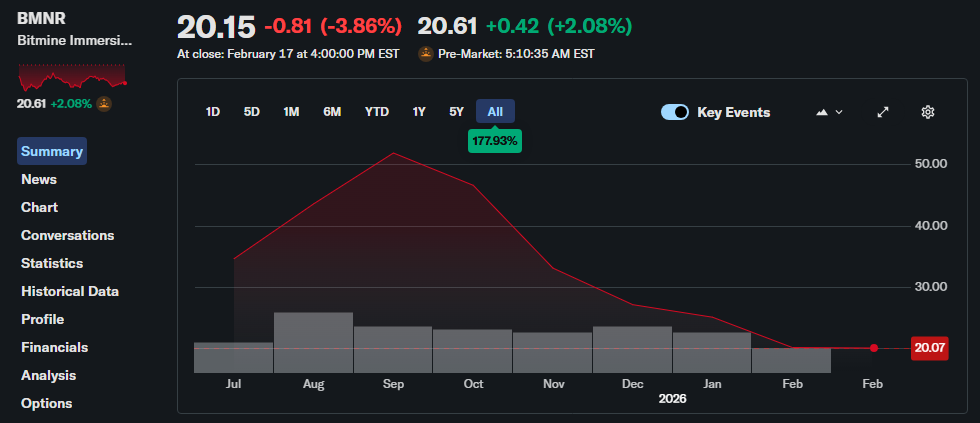
Tom Lee has been in charge of Bitmine's board since June 2025. He has been in charge of the company's change to a Digital Asset Treasury Company (DATCO) focused on Ethereum. He balances this with his duties at Fundstrat, where he gives strategic direction but doesn't run the day-to-day operations.
"The Alchemy of 5%," which means getting and staking about 5% of Ethereum's supply for yield and long-term positioning, is what gives him power. By February 2026, Bitmine owned about 4.326 million ETH, which was about 3.58% of the total supply. This was worth about $10 billion, including cash. About 2.9 million ETH were staked for annualized rewards of $202 to $374 million.
"ETH Yield" (Ethereum per share) was selected as the primary KPI by Lee. This is like Strategy's Bitcoin metric. He was in charge of raising money, which included a $250 million pipe in June 2025 and up to $20 billion in ATM authorizations. These funds were used to buy shares at prices above NAV. This plan turned Bitmine into the biggest public ETH treasury and the second biggest crypto treasury overall.
Under Tom Lee's leadership, BitMine got more interest from institutions. Founders Fund bought a 9.1% stake, ARK Invest converted $182 million to ETH, and Galaxy Digital backed the company. Lee calls Bitmine Ethereum's MicroStrategy equivalent, and he talks about how staking ETH makes it more productive than Bitcoin's pure hold model.
His style, data-driven and subtle, shows in how he responds to criticism (for example, when he defends the thesis against claims of financial illiteracy by pointing out how stablecoins are the most popular on Ethereum).
Bitmine’s position in the crypto mining industry
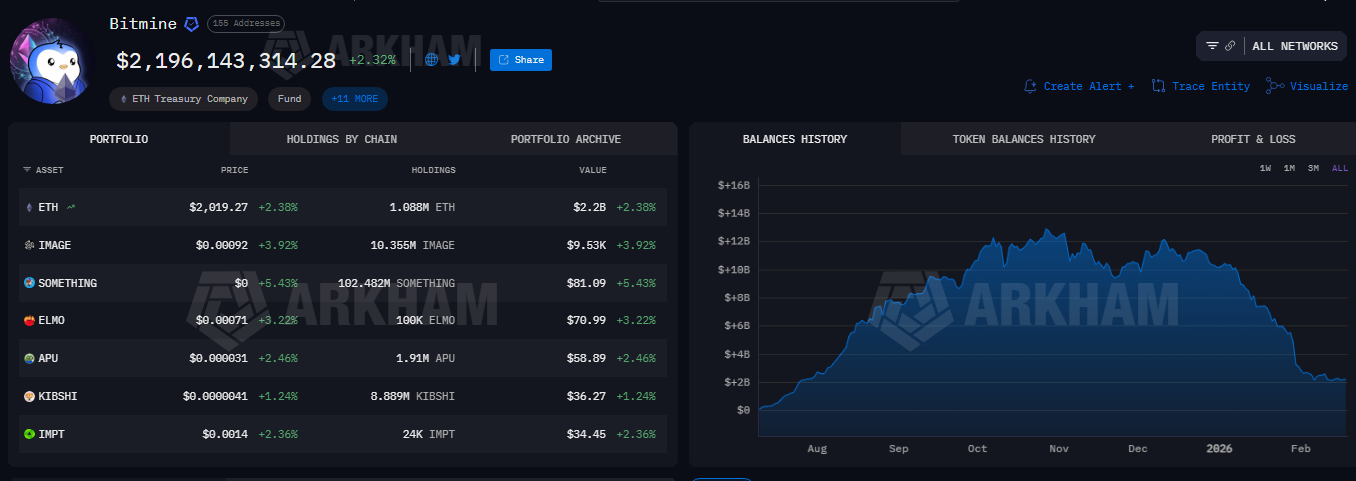
Bitmine Immersion Technologies, which is based in Las Vegas, began as a Bitcoin miner that used immersion cooling (submerging hardware in dielectric fluids for 25-30% hashrate gains and ~40% energy savings). It mines on its own in cheap places in Texas (Pecos, Silverton) and Trinidad, and it also offers Mining-as-a-Service (MaaS) to other people.
The Ethereum pivot shows how important it is right now: as the biggest public ETH holder, it stakes its holdings through the upcoming Made in America Validator Network (MAVAN, launching in Q1 2026) for high-yield operations in the US. Mining profits go back into ETH, which creates a cycle that traditional miners don't have.
BMNR is a popular way for institutions to get exposure to ETH because it has a high liquidity (about $1 billion in daily volume). It also solves problems with mining, like halvings, and is part of Ethereum's stablecoin ecosystem (with a market cap of $250 billion and 50%+ issuance on-chain).
Thomas Lee’s strategic focus
Volatility is a natural part of long-term assets, according to Tom Lee, saying, "feature, not a bug." He thinks that events like the October 2025 liquidation are like resets for leverage, just like Bitcoin's historical drops. Bitmine's liquidity helps institutions manage risk.
Traditional four-year cycles are breaking apart into long-term trends due to ETFs and treasuries, according to Tom Lee. He uses macro indicators like the ISM Manufacturing Index and the Copper-to-Gold ratio to find bottoms. He calls Ethereum the "1971 moment" for on-chain finance and the "tokenization supercycle" for the long term. It is the base layer for RWAs and stablecoins.
Staking through MAVAN aims for big daily rewards, which shows that ETH has a yield edge. Lee's method of buying dips during drawdowns fits with his long-held belief in growth driven by adoption.
After attending last week’s Consensus Hong Kong conference, Tom Lee described 2026 as a defining year for Ethereum.
“We see strengthening product-market fit emerging on the back of three long-duration secular drivers: (i) Wall Street via tokenization/privacy on Ethereum; (ii) AI and AI-agents using Ethereum for both collecting payments as well as verification; and (iii) creators leaning towards 'proof of human' and other standards running on Ethereum layer-2 (Worldchain, etc).”
Lee's approach to crypto infrastructure
Thomas Lee's tenure as chairman of Bitmine has involved overseeing the company's Ethereum treasury accumulation while maintaining its Bitcoin mining operations. His verifiable past, which includes fights with JPMorgan and early cryptocurrency valuation models at Fundstrat, aligns with Bitmine's current Ethereum treasury approach and makes it an example of a Digital Asset Treasury Company (DATCO) model. Bitmine's treasury strategy prioritizes long-term positioning and yield generation through staking. As Bitmine advances toward its 5% ETH target, the strategy combines ongoing Bitcoin mining revenue with Ethereum treasury accumulation and staking.
 Anastasiia G
Disclaimer: All materials on this site are for informational purposes only. None of the material should be interpreted as investment advice. Please note that, despite the nature of much of the material created and hosted on this website, HODL FM operates as a media and informational platform, not a provider of financial advisory services. The opinions of authors and other contributors are their own and should not be taken as financial advice. If you require advice, HODL FM strongly recommends contacting a qualified industry professional.