



World Liberty Financial has introduced a governance proposal that would require holders of unlocked WLFI tokens to stake them in order to vote while creating a tiered system designed to redirect stablecoin arbitrage value to long-term participants.
The proposal, titled the WLFI Governance Staking System, sets out structural changes to how governance power is earned and exercised across the WLFI ecosystem. It also introduces new incentives tied to USD1, the platform’s flagship stablecoin.
The abstract states that WLFI tokens function as the consensus mechanism for determining the community’s direction. The proposal outlines four objectives: encourage active governance participation, require staking as a prerequisite for voting with unlocked tokens, reward participation, and establish a tiered node framework that links governance commitment to access and incentives.
Staking required for unlocked tokens
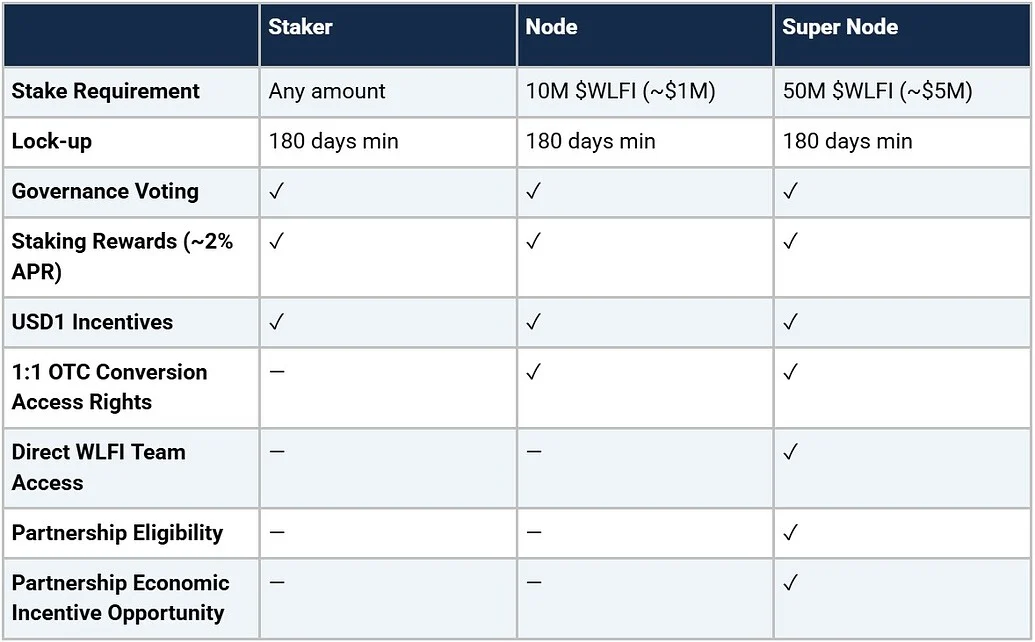
Under the plan, holders of unlocked WLFI must stake their tokens to participate in governance votes. A minimum lock-up period of 180 days would apply. Holders of locked tokens would remain eligible to vote without additional staking.
Voting power would depend on both the amount staked and the remaining lock-up duration. The formula would apply square root weighting to limit concentration of influence among the largest holders. All current limitations on voting power would be removed if the proposal passes.
Governance rights would be non-transferable and dynamic. Voting strength would adjust as the lock-up period declines.
Stakers would receive a base WLFI reward with a target annual percentage rate of about 2% for active governance participation. Eligibility for rewards would require participation in at least two governance votes during the lock-up period. The proposal specifies that the staking reward rate would be paid from the WLFI treasury and determined at WLFI’s discretion. It would not be tied to revenue or operational performance metrics.
The document also states:
“Whether, when or how or much $WLFI is determined solely by the staker.”
Only staking participants would receive USD1 deposit incentives on WLFI Markets provided by Dolomite. Non-staking participants would not qualify for those incentives.
Redirecting arbitrage profits
The motivation section highlights concerns about value distribution during USD1’s recent expansion phase. According to the proposal, market makers captured millions in arbitrage profits, estimated at about 15 basis points per minting and selling cycle. WLFI also paid millions in subsidies to facilitate redemptions.
The new structure would attempt to redirect that value. The Node mechanism would pass the arbitrage opportunity, previously captured by institutional market makers at around 10 to 15 basis points, to committed governance participants.
The strategic rationale explains that the system would shift value from a small group of intermediaries to long-term ecosystem participants while creating structural demand pressure on competing stablecoins.
Node and Super Node tiers
The proposal introduces a tiered structure. Participants who stake at least 10 million WLFI, approximately $1 million at current prices, would qualify as Nodes. Nodes would gain access to licensed market makers who facilitate 1:1 conversions of supported stablecoins such as USDT and USDC into USD1, as well as off-ramp USD1 directly into US dollars.
WLFI would subsidize market makers to maintain 1:1 parity. The proposal reserves the right for WLFI to modify or discontinue subsidies at any time. Node participants would need to complete standard KYC and onboarding procedures required by licensed market makers.
An additional reward based on the USDT to USD1 conversion volume would be issued in the governance token. This incentive would be limited to the first 1,000 Nodes and settled every six months.
At a higher threshold, Super Nodes would require a stake of at least 50 million WLFI, approximately $5 million at current prices. Super Nodes would receive all Node privileges plus guaranteed direct access to the WLFI team for partnership discussions. The Super Node status does not guarantee partnership agreements, which remain subject to commercial, technical and compliance review.
The document states that WLFI currently receives more partnership inquiries than it can engage with productively. The Super Node requirement would serve as a filter to prioritize projects that actively support WLFI governance and the ecosystem.
Voting process and implementation
The proposal requires a quorum of 1,000,000,000 eligible WLFI voting tokens. A simple majority of votes cast, excluding abstentions, would determine the outcome. The voting period would last seven days from the date the proposal is submitted to Snapshot.
If approved, implementation would proceed in three phases. Phase one would launch governance staking for unlocked WLFI holders and activate staking rewards and USD1 deposit incentives. Phase two would activate the Node tier after finalizing licensed market maker partnerships. Phase three would activate the Super Node tier and establish a partnership access and revenue framework.
Specific timelines would be communicated after the voting period concludes.
The proposal frames the overhaul as a mechanism to align governance participation with long-term capital commitment while restructuring how USD1-related value flows through the ecosystem.
 Matvii Diadkov
Disclaimer: All materials on this site are for informational purposes only. None of the material should be interpreted as investment advice. Please note that, despite the nature of much of the material created and hosted on this website, HODL FM operates as a media and informational platform, not a provider of financial advisory services. The opinions of authors and other contributors are their own and should not be taken as financial advice. If you require advice, HODL FM strongly recommends contacting a qualified industry professional.