


World Liberty Financial has pushed back against mounting concerns over its lending activity on Dolomite, as scrutiny grows around the project’s large collateral position and its potential impact on the broader ecosystem.
The debate intensified after onchain data from Arkham revealed that a wallet linked to the project deposited roughly 5 billion WLFI tokens into Dolomite. The platform then used that collateral to borrow about $75 million in stablecoins, including USD1 and USDC. A portion of those funds, more than $40 million, later moved to Coinbase Prime within hours of a public geopolitical development tied to a U.S.-Iran ceasefire.
Let's talk about the FUD going around our WLFI Markets lending position.
— WLFI (@worldlibertyfi) April 9, 2026
It's wrong. Here's what's actually happening — and why the real story is a lot more interesting.
Data sparks risk concerns across DeFi community
The size of the position drew attention due to its dominance within Dolomite. Platform data shows that WLFI accounts for approximately $428.9 million out of $825.4 million in total supplied assets. That share represents more than half of the protocol’s liquidity.
Several DeFi researchers raised concerns on X, citing concentration risk and the potential for bad debt if market conditions shift. One widely shared post from analyst EthanDeFi warned,
“If that WLFI collateral position ever gets close to liquidation, it's basically unliquidatable without major losses for lenders.”
The concern centers on liquidity depth. Critics argue that if WLFI’s price falls toward liquidation thresholds, the market may not absorb large sell-offs without significant slippage. This scenario could leave lenders exposed.
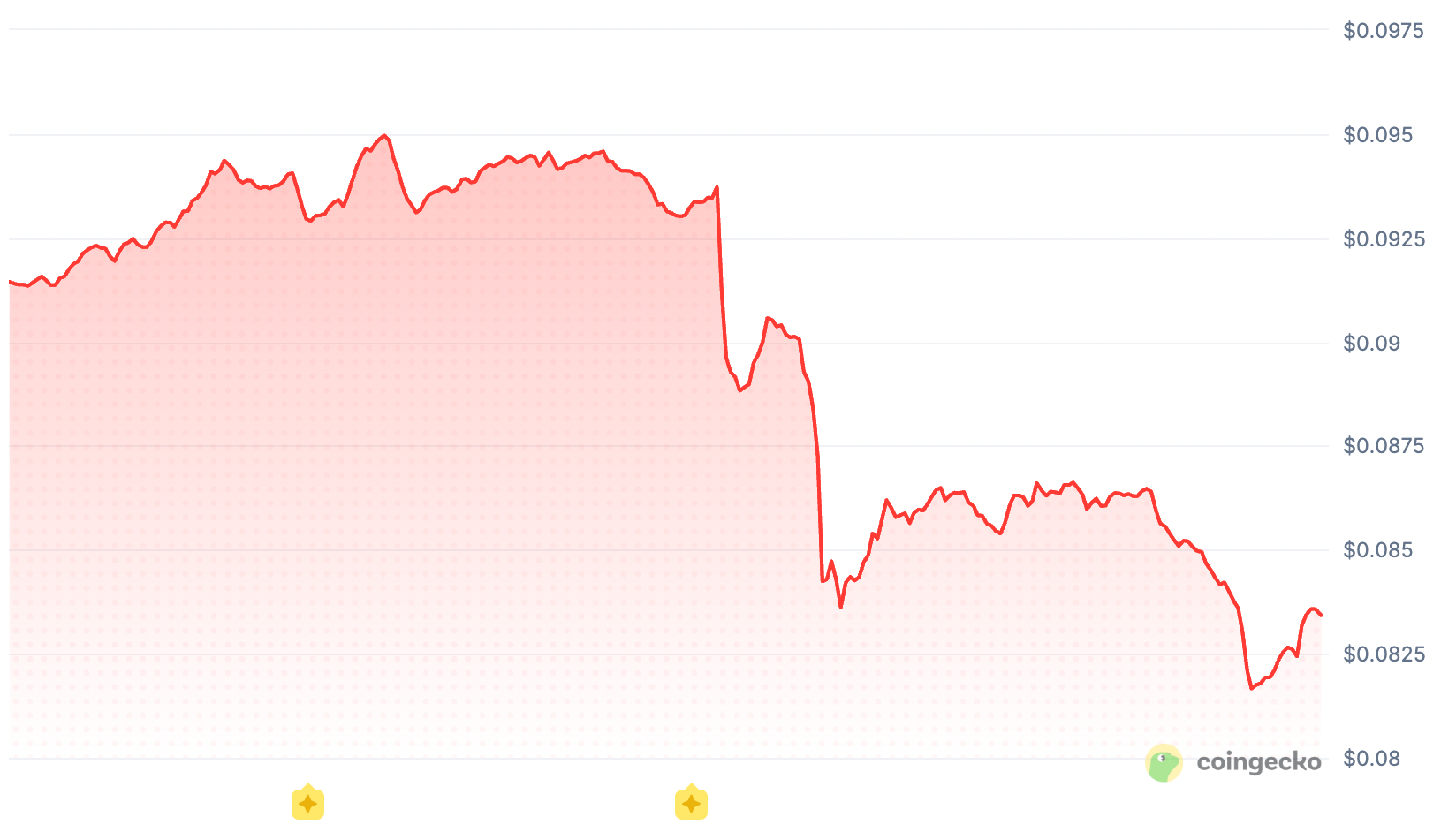
Market reaction followed the discussion. WLFI’s price dropped 8.8% over 24 hours to $0.83 as the topic spread across social media, according to CoinGecko data.
Project dismisses claims as misinformation
World Liberty responded through a series of posts on X, rejecting the narrative that its position carries imminent risk. The team described the criticism as FUD and emphasized its role within the protocol.
“We are one of the largest suppliers and borrowers on WLFI Markets,” the project stated. “Yes, we supplied WLFI as collateral and borrowed stablecoins. No, we are nowhere near liquidation — and frankly, even if markets moved dramatically against us, we'd simply supply more collateral. That's not a risk. That's how this works.”
The project framed its position as structural rather than speculative. It described itself as an “anchor borrower” that supports yield generation for other users on the platform.
“By being the anchor borrower, we're generating the yield that makes WLFI Markets compelling for everyone else,” the team wrote. “Everyday users are earning outsized stablecoin yields right now — at a time when traditional markets are offering very little. That's the whole point.”
Revenue, buybacks, and token support highlighted
World Liberty also disclosed internal performance metrics in its response. According to the team, its USD1 stablecoin operates at a $159.5 million annual revenue run rate.
The project highlighted token buybacks as a sign of long-term commitment. Over the past six months, it has repurchased 435,301,344 WLFI tokens at an average price of $0.1507. These purchases total $65.58 million, based on figures shared by the team and supported by Etherscan data.
“Not because we had to. Because we believe in where this is going,” the project stated.
The team also pointed to recent upgrades to USD1, including gasless transfers and infrastructure designed for AI-driven payment systems. It described the stablecoin as “built for compliance” with enhanced controls for fund management.
Governance vote and token unlock ahead
Attention has also shifted to governance plans. World Liberty confirmed that it will introduce a proposal to unlock tokens for early participants. The vote will follow community discussion and focus on a phased release rather than a full unlock.
“The vote will be on a long-term vesting and unlock schedule for retail early purchasers — a structured, phased approach designed with the long-term health of the ecosystem in mind,” the project stated in a separate update.
This development comes at a time when investor confidence faces pressure from recent price declines and ongoing debate about collateral risk.
Ties to advisors and platform structure questioned
The relationship between World Liberty and Dolomite has added another layer to the discussion. Dolomite was co-founded by Corey Caplan, who also serves as an advisor to World Liberty. This overlap has drawn attention from market participants who question governance and risk distribution within the ecosystem.
Despite these concerns, the project maintains that its design prioritizes long-term growth.
“The critics are looking at the wrong thing,” the team wrote. “We're building something that compounds.”
So to recap:
— WLFI (@worldlibertyfi) April 9, 2026
✓ No liquidation risk
✓ Users earning exceptional stablecoin yields
✓ $65M+ in token buybacks
✓ Governance proposal incoming to unlock locked tokens for early holders
✓ USD1 built for the agentic economy
The critics are looking at the wrong thing. We're…
The situation places World Liberty at the center of a broader conversation about DeFi risk management. Large collateral positions can support liquidity and yield. At the same time, they can introduce systemic exposure when concentration rises beyond typical thresholds.
The coming weeks may prove decisive. Market conditions, governance decisions, and user behavior will shape how the protocol evolves under scrutiny.
 Roman Zaika
Disclaimer: All materials on this site are for informational purposes only. None of the material should be interpreted as investment advice. Please note that, despite the nature of much of the material created and hosted on this website, HODL FM operates as a media and informational platform, not a provider of financial advisory services. The opinions of authors and other contributors are their own and should not be taken as financial advice. If you require advice, HODL FM strongly recommends contacting a qualified industry professional.