



TeraWulf Inc. reported higher revenue for 2025 as it accelerated its transition from bitcoin mining to high-performance computing and artificial intelligence infrastructure, though losses widened sharply during the year.
The Nasdaq-listed company posted $168.5 million in total revenue for the full year ended December 31, 2025, up about 20% from $140.1 million in 2024. The figure included $16.9 million from its first full year of HPC lease operations, which the company launched as part of a broader shift toward long-term data center hosting.
Net loss expanded to $661.4 million from $72.4 million a year earlier. The company attributed the swing largely to a $429.8 million change in the fair value of warrant and derivative liabilities. Non-GAAP adjusted EBITDA came in at negative $23.1 million, compared with positive $60.4 million in 2024.
TeraWulf described 2025 as an inflection point. It executed long-term data center lease agreements covering 522 megawatts of critical IT load, representing more than $12.8 billion in contracted customer revenue. The company also completed $6.5 billion in long-term financings tied to its HPC platform build-out.
Mining revenue weakens in the fourth quarter
Fourth-quarter results reflected continued volatility in bitcoin economics. Digital asset revenue fell to $26.1 million in the three months ended December 31, 2025, down from $43.4 million in the prior quarter. The company said the decline was “primarily driven by lower bitcoin production and the price of bitcoin during the fourth quarter.”
HPC lease revenue moved in the opposite direction. The segment generated $9.7 million in the fourth quarter, compared with $7.2 million in the third quarter.
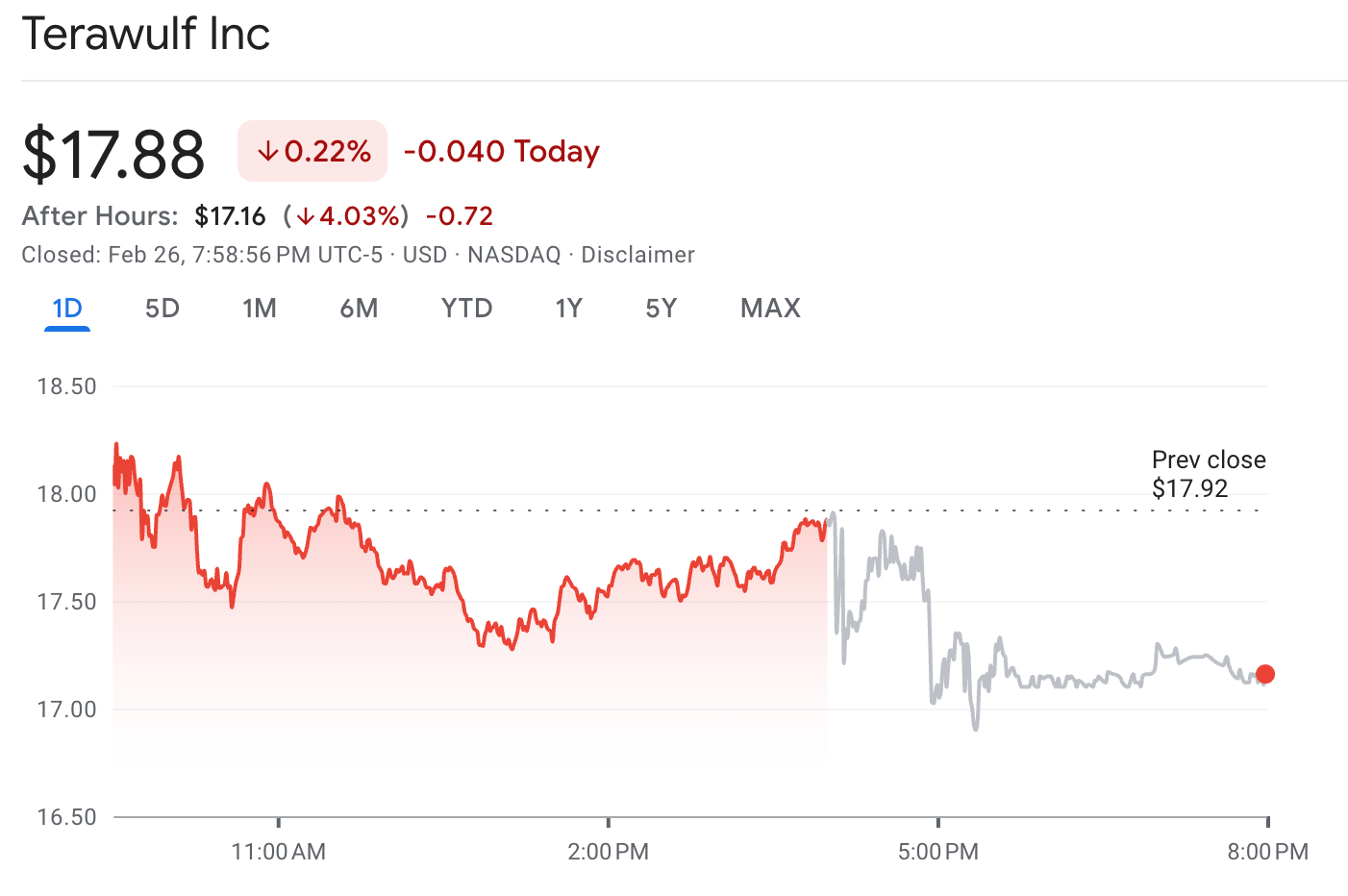
Shares closed at $17.88 on Thursday, down 0.22% on the day. The stock gained 29.66% over the past month, according to Google Finance data.
Lake Mariner anchors long-term strategy
The company’s HPC strategy centers on its Lake Mariner campus in New York and the Abernathy HPC campus in Texas.
At Lake Mariner, TeraWulf secured long-term lease commitments for 60 critical IT MW with Core42 and 380 critical IT MW with Fluidstack. The Fluidstack agreement includes credit enhancement from Google. The combined commitments position the campus as a hyperscale-ready AI infrastructure site with long-dated contracted revenue.
As of year-end, 39 critical IT MW of HPC capacity stood online at Lake Mariner. The company outlined a phased construction schedule. CB2B targets completion in March 2026. CB3 targets mid-May 2026. CB4 and CB5 target the third and fourth quarters of 2026, respectively. Design optimization increased capacity for CB4 and CB5 from 162 MW to 168 MW per building without raising base construction budgets.
“These projects reflect disciplined construction execution and close coordination with our hyperscale stakeholder and customers,” Chief Technology Officer Nazar Khan said in the press release. “Our teams are advancing build schedules, integrating tenant fit-out requirements, and optimizing cooling, electrical, and design architecture to support next-generation AI workloads at scale.”
The company also controls the Cayuga site in New York, which can support up to 320 critical IT MW subject to permitting and development.
Texas joint venture and new sites expand footprint
In October 2025, TeraWulf entered a joint venture with Fluidstack to develop the 168 critical IT MW Abernathy HPC Campus in Texas. The campus operates under a 25-year lease with annual escalators and carries Google credit support. Delivery targets the second half of 2026.
Subsequent to year-end, TeraWulf announced acquisitions of brownfield infrastructure sites in Kentucky and Maryland. The additions raise total platform capacity to about 2.9 gigawatts gross across five sites. The company outlined a multi-year development pipeline that can deliver 250 to 500 critical IT MW annually through the end of the decade.
TeraWulf ended 2025 with $3.7 billion in cash, cash equivalents, and restricted cash, compared with $274.1 million at the end of 2024. The increase reflects $3.1 billion in long-term debt proceeds and $1.97 billion raised through convertible notes.
CEO Paul Prager said in the earnings statement:
“We enter 2026 with 522 critical IT MW of contracted HPC capacity and a gross 2.9-GW multi-regional platform designed for long-term expansion. Our focus remains on disciplined execution, transparent capital allocation, and converting energy-advantaged infrastructure into durable, long-term cash flow.”
The results illustrate a company in transition. Bitcoin mining revenue fluctuates with production levels and price swings. Long-term AI and cloud leases offer contracted visibility but require large upfront capital commitments. TeraWulf’s balance sheet expansion and construction schedule now set the pace for 2026.
 Tanya Petrusenko
Disclaimer: All materials on this site are for informational purposes only. None of the material should be interpreted as investment advice. Please note that, despite the nature of much of the material created and hosted on this website, HODL FM operates as a media and informational platform, not a provider of financial advisory services. The opinions of authors and other contributors are their own and should not be taken as financial advice. If you require advice, HODL FM strongly recommends contacting a qualified industry professional.