


OP Labs, the core developer team behind the Optimism layer-two network, has cut about 20 positions as the company moves to streamline internal operations and narrow its priorities.
Jing Wang, CEO of OP Labs and co-founder of Optimism, confirmed the decision in a message shared with employees. A screenshot of the internal communication showed a company chat with 102 members, which suggests that about 19.6% of the workforce lost their jobs.
“This is not about finances. OP Labs is well capitalized with years of runway,” Wang wrote in the message. “This is about doing fewer things well, making decisions faster, and reducing coordination overhead.”
Wang did not disclose which roles were affected. She encouraged recruiters and hiring managers to reach out to the departing employees. She described them as “talented engineers, operators, and builders who helped build Optimism into what it is today.”
The layoffs mark one of the most significant organizational shifts inside the team responsible for Optimism’s development.
Today we shared difficult news with the OP Labs team.
— Optimist Prime (@jinglejamOP) March 12, 2026
Our priority was to communicate with the impacted people & give the team time to process the news before sharing publicly. This decision reflects a narrowing of our focus, not our runway.
I’m sharing the note I sent to the… pic.twitter.com/rJThhlcFaw
Optimism faces a transition period
Optimism serves as one of the largest layer-two scaling solutions for Ethereum. The network processes transactions off the main chain and later settles them on Ethereum. This approach reduces costs and congestion for decentralized applications.
The network currently holds more than $1.5 billion in total value locked, according to L2BEAT data. Optimism also reached the first stage of decentralization, a milestone that signals partial governance and operational independence from a central entity.
OP Labs maintains the OP Stack, an open-source software framework used to create customizable blockchains. Several major networks rely on this infrastructure, including Coinbase’s Base chain.
Recent developments, however, have introduced pressure on the ecosystem.
Base announced in February that it would move toward its own unified technology stack to pursue independent development. Base had represented the largest network built on the OP Stack and accounted for a substantial share of revenue within the broader Superchain ecosystem.
OP Labs had previously acknowledged the financial implications. Wang stated at the time that Base’s exit represented “a hit to near-term on-chain revenues.”
OP token reacts to uncertainty
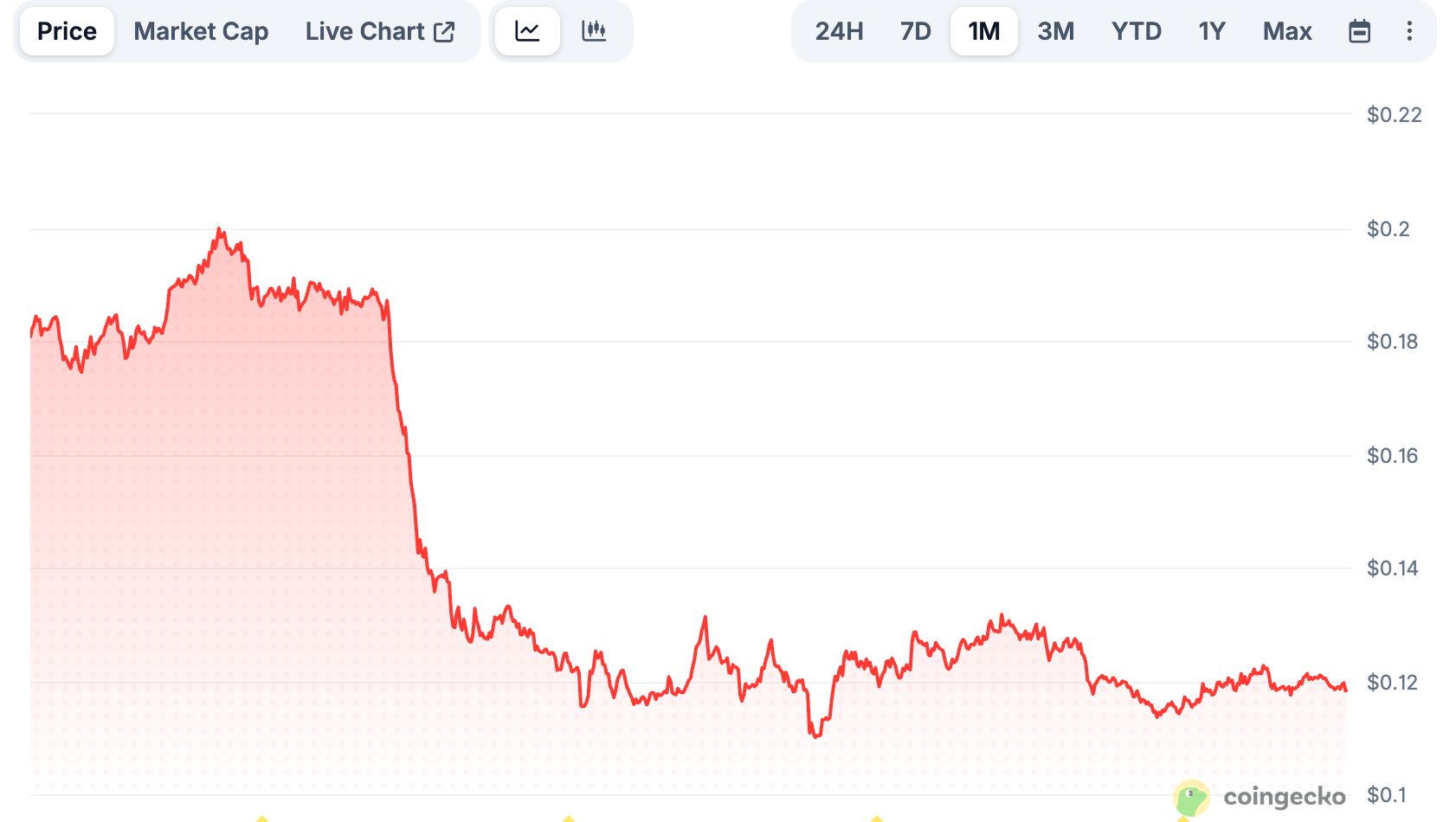
Market sentiment around the project has weakened in recent weeks. The native OP token has declined sharply during the past month, according to CoinGecko data.
The asset has dropped about 34.5% over the last 30 days and traded around $0.11 at the time of reporting. The price stands far below its all-time high of $4.84 recorded in March 2024.
Earlier in the year, OP holders approved a governance proposal that directs 50% of Superchain sequencer revenue toward monthly OP token buybacks. The pilot program runs for 12 months and aims to strengthen the relationship between network activity and token demand.
Despite these initiatives, uncertainty about ecosystem revenue and development priorities continues to influence the token’s trajectory.
Debate continues around the future of layer two
The broader Ethereum community has begun debating the long-term role of layer-two networks.
Ethereum co-founder Vitalik Buterin recently argued that the relevance of rollups could change as the Ethereum mainnet scales further. He also stated that rollups have decentralized more slowly than expected.
Buterin suggested that developers should pursue specialized use cases rather than replicate the capabilities of the base chain. He highlighted privacy-focused applications, high-speed environments, and non-financial blockchain use cases as areas with potential.
As a technical direction, he proposed a “native rollup precompile,” a protocol-level feature designed to verify zero-knowledge proofs directly within Ethereum.
Some layer-two developers have responded that Ethereum’s base layer still cannot match rollup throughput. Companies such as Offchain Labs maintain that layer-two systems remain essential for transaction scalability.
Optimism outlines plans for 2026
OP Labs continues to outline development goals despite the restructuring.
The team has identified faster block production as a priority for the coming year. Developers also plan to introduce native interoperability across networks that rely on the OP Stack.
Other objectives include compliance controls tailored to different jurisdictions and zero-knowledge proof systems aligned with Ethereum’s quantum-resistant roadmap.
In March, the Ethrex development team released code and documentation for a ready-to-use environment for native rollups. The project involved collaboration with the Ethereum Foundation and L2BEAT.
Wang told employees that the layoffs will not lead to the same workload distributed among fewer people. Certain projects will stop entirely while others continue with a narrower focus.
Base forked the OP Stack. Here's how I'm thinking about it from a technical and economic standpoint.
— Optimist Prime (@jinglejamOP) February 18, 2026
Tech: OP Stack continues to be the best stack my frens. Make no mistake - it is a combination of our tech and Coinbase GTM that made Base the biggest L2. As Base grew, we…
Further updates about the development roadmap are expected as the company defines its new priorities.
Tech sector layoffs continue across companies
The job cuts at OP Labs reflect a broader pattern across technology and fintech companies.
HODL FM reported earlier that several major firms have begun workforce reductions this year. Meta Platforms cut roughly 10% of employees in its Reality Labs division, which focuses on virtual and augmented reality products.
Block Inc. also reduced its workforce by about 10%, or roughly 4,000 roles, at the end of February 2026. The company has pursued restructuring since 2024 as it focuses resources on bitcoin infrastructure, payments services, and artificial intelligence tools.
These reductions illustrate a wider shift across the technology sector. Companies continue to tighten operations, narrow product strategies, and concentrate investment on areas with clearer commercial returns.
For OP Labs, the restructuring represents a similar adjustment period as the Optimism ecosystem enters a new phase of development.
 Matvii Diadkov
Disclaimer: All materials on this site are for informational purposes only. None of the material should be interpreted as investment advice. Please note that, despite the nature of much of the material created and hosted on this website, HODL FM operates as a media and informational platform, not a provider of financial advisory services. The opinions of authors and other contributors are their own and should not be taken as financial advice. If you require advice, HODL FM strongly recommends contacting a qualified industry professional.