

Bitcoin mining firm MARA Holdings closed out the fourth quarter of 2025 with a sharp reversal from the year before, reporting a $1.71 billion net loss as the market value of its Bitcoin holdings fell during the period.
The company’s latest shareholder update and filings with the U.S. Securities and Exchange Commission show how heavily miners’ balance sheets can swing when prices move quickly.
A year earlier, MARA had posted $528.3 million in net income.
Bitcoin price swing drove the quarterly hit
This time, the quarter landed at a loss of $4.52 per diluted share. Much of that change came from accounting adjustments tied to the value of the company’s digital assets rather than a sudden collapse in operations.
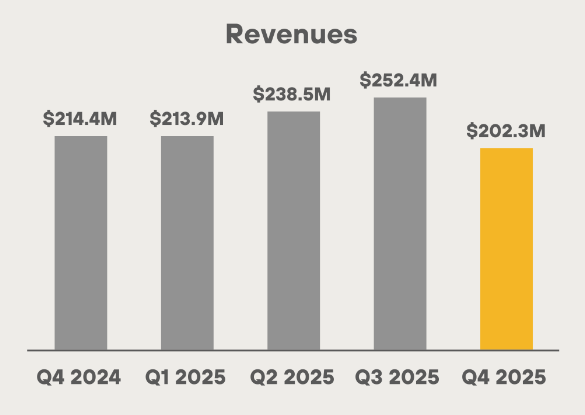
MARA’s revenue fell slightly to $202.3 million in Q4, down from $214.4 million a year earlier, as a lower Bitcoin price offset gains from a bigger mining fleet.
The largest factor behind the loss was a $1.5 billion negative change in the fair value of digital assets and related receivables. During the quarter, Bitcoin’s price fell from roughly $114,300 at the end of September to about $88,800 by Dec. 31, according to market data tracked by CoinGecko.
For companies that hold large reserves of BTC, those valuation changes can move earnings dramatically on paper.
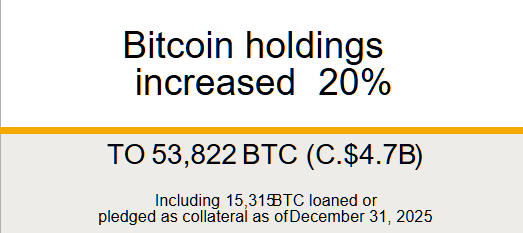
MARA finished the year holding 53,822 BTC, including coins that were loaned out or pledged as collateral. At the quarter-end price used in the report, the company valued its Bitcoin balance sheet at roughly $4.7 billion.
Mining output also slowed compared with earlier periods. MARA mined 2,011 BTC during the fourth quarter, down from 2,144 BTC in the previous quarter and below the 2,492 BTC mined in the same period in 2024. For the full year, production reached 8,799 BTC, compared with 9,430 BTC the year before.
Annual revenue rose to $907.1 million from $656.4 million in 2024, yet the company still recorded a net loss of $1.31 billion for the year.
A shift toward AI and data center infrastructure
Alongside the earnings report, MARA outlined a longer-term strategy that moves beyond pure Bitcoin mining. In its shareholder letter, the company described a push into artificial intelligence infrastructure and high-performance computing through a joint venture with Starwood Digital Ventures.
“Our partnership with Starwood will allow us to turn that power certainty into capacity certainty, so customers can run diverse workloads close to their data and users. said Fred Thiel, MARA’s Chairman and CEO.
The partnership is designed to build data centers at sites where MARA already controls significant power resources.
Initial plans target more than 1 gigawatt of IT capacity, with the possibility of expanding past 2.5 gigawatts over time. MARA will have the option to invest up to half of individual projects while continuing mining operations where electricity remains competitive.
The company has been gradually positioning itself for that shift. Earlier this year, it acquired a 64% stake in Exaion, aiming to support enterprise and “sovereign-grade” AI deployments. Executives framed the move as part of a broader transition toward what they describe as an energy-driven digital infrastructure platform, where computing workloads compete for power capacity.
Control over power sources appears central to that approach. MARA noted that it holds or has contractual rights to nearly 2 gigawatts of capacity across its portfolio and has expanded projects tied to wind and gas-to-power generation, which can feed both mining operations and potential data center clients.
Mining sector experiments with new models
MARA’s pivot reflects a wider shift among publicly listed miners as the industry adapts to volatile Bitcoin cycles and changing economics. Some companies are exploring AI data center hosting as a way to stabilize revenue tied to electricity and infrastructure.
For example, Hut 8 recently reported a sizable quarterly loss while advancing a multibillion-dollar AI data center leasing strategy. Another player, American Bitcoin, has continued emphasizing a mine-and-hold approach, focusing on accumulating BTC despite market drawdowns.
MARA’s latest results show both sides of that environment at once: a balance sheet shaped by Bitcoin’s price swings and a business increasingly built around energy, compute capacity, and long-term infrastructure bets.
 Oleksii Shumak
Disclaimer: All materials on this site are for informational purposes only. None of the material should be interpreted as investment advice. Please note that, despite the nature of much of the material created and hosted on this website, HODL FM operates as a media and informational platform, not a provider of financial advisory services. The opinions of authors and other contributors are their own and should not be taken as financial advice. If you require advice, HODL FM strongly recommends contacting a qualified industry professional.