



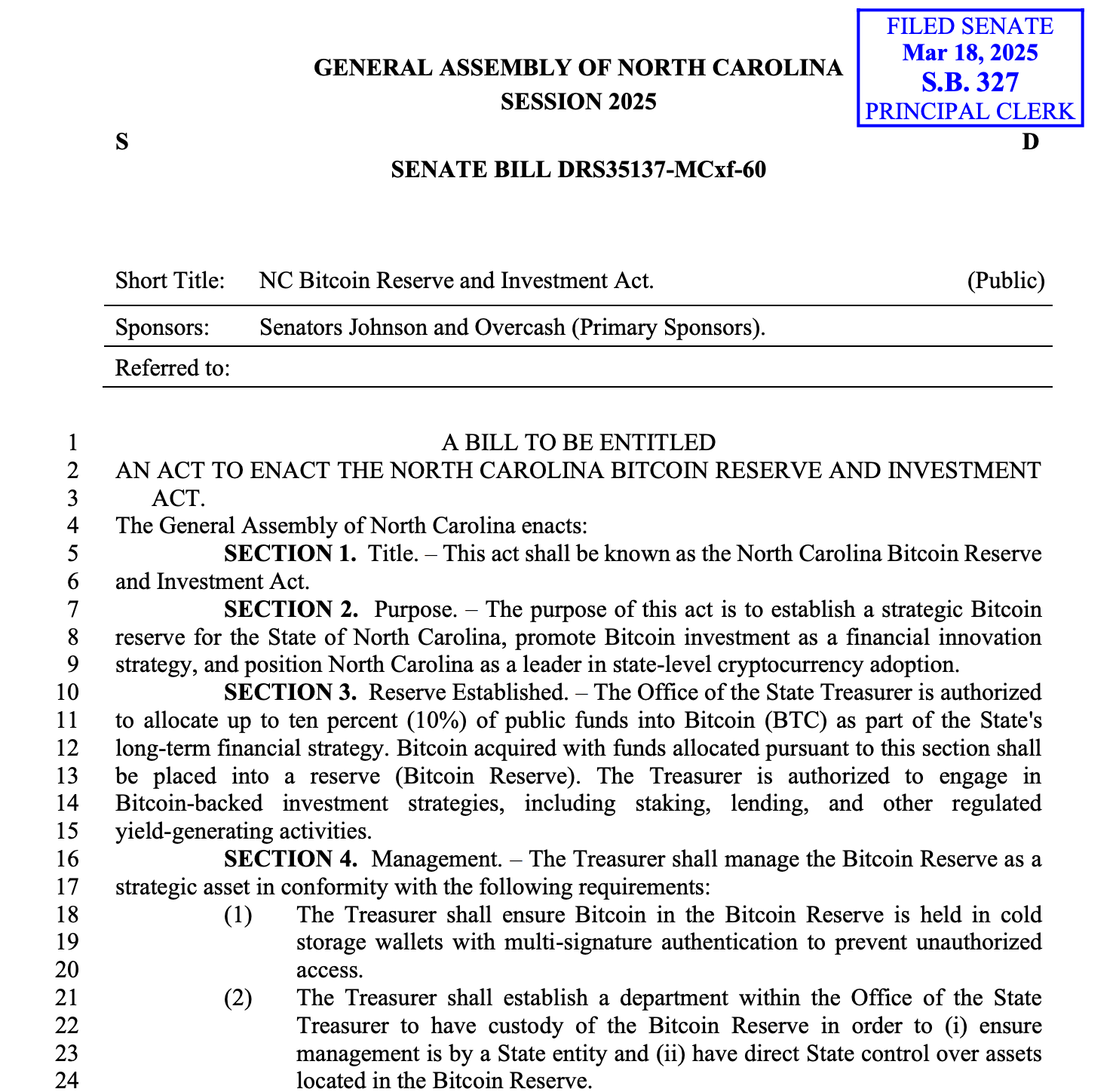
Lawmakers in North Carolina have introduced legislation that would authorize the creation of a state-controlled Bitcoin reserve, which would place public funds directly into digital assets under a structured framework. The proposal, titled the NC Bitcoin Reserve and Investment Act, appears as Senate Bill 327 during the 2025 legislative session.
The bill passed its first Senate reading and now sits with the Rules and Operations Committee. It outlines a plan that allows the Office of the State Treasurer to allocate up to 10% of public funds into Bitcoin as part of a long-term financial strategy. The legislation states that its purpose is to establish a strategic Bitcoin reserve, promote Bitcoin as a financial innovation, and position the state as a leader in cryptocurrency adoption.
Treasury control and custody rules define structure
Under the proposal, the Treasurer would maintain direct control over the reserve. The bill requires the creation of a dedicated department within the Treasurer’s office to oversee custody and management. Instead of depending on outside custodians, this structure assigns accountability to a state entity.
Security provisions form a central part of the framework. The legislation mandates cold storage wallets with multi-signature authentication to prevent unauthorized access. It also requires monthly audits to verify the reserve’s balance, security, and financial performance. The Treasurer must implement state-backed insurance policies designed to protect the reserve from cyber threats and economic risks.
The bill calls for the formation of a Bitcoin Economic Advisory Board composed of industry experts. The board would provide ongoing guidance to support decision-making related to reserve management and strategy.
Acquisition strategy includes exchanges and mining
The legislation sets clear rules for how Bitcoin would enter the reserve. Purchases must take place through regulated U.S.-based cryptocurrency exchanges to ensure compliance with federal and state laws. The Treasurer would conduct bulk purchases to take advantage of market conditions.
The bill also directs the Treasurer to explore Bitcoin mining as an additional method to increase holdings. The provision introduces a second pathway for accumulation beyond direct market purchases.
Strict limits on use and liquidation
The proposal treats the Bitcoin reserve as a long-term asset rather than a liquid fund. It restricts use to specific scenarios. These include responding to a severe financial crisis when other reserves prove insufficient, participating in approved investment strategies, and funding critical infrastructure or economic development projects approved by the General Assembly.
The reserve may also support research, education, and business incentives related to Bitcoin and digital assets. Another provision allows the state to use Bitcoin holdings to back bonds as an alternative financing mechanism.
Liquidation rules impose a high threshold. Any sale of Bitcoin requires approval from at least two-thirds of both chambers of the General Assembly present and voting. This condition reinforces the long-term nature of the reserve and limits short-term policy shifts.
Reporting and compliance requirements
Transparency requirements appear throughout the bill. The Treasurer must submit quarterly reports to the General Assembly that detail the reserve’s status, value, and performance. These reports must also be made publicly available on the Treasurer’s website.
The legislation also requires full compliance with applicable federal and state laws related to cryptocurrency holdings and taxation. It includes a directive for the state to advocate for Bitcoin-friendly regulations at the federal level.
Broader state-level momentum builds
The proposal in North Carolina reflects a wider movement across the United States. States such as Texas, New Hampshire, and Arizona have enacted laws that allow some level of Bitcoin allocation within state financial strategies.
Other states, including Maryland, Illinois, and Tennessee, have introduced similar proposals. Some remain under consideration in committees, while others have stalled or failed to pass.
The North Carolina bill stands out due to its allocation ceiling of up to 10% of public funds and its detailed operational framework. It also explicitly allows Bitcoin-backed investment strategies such as lending or other regulated yield-generating activities.
Operational risks and early challenges emerge
The structure outlined in the bill addresses several operational risks that often appear in public-sector digital asset discussions. Cold storage and multi-signature controls aim to reduce exposure to cyber threats. Monthly audits and internal custody reduce reliance on third parties.
"The Treasurer shall ensure Bitcoin in the Bitcoin Reserve is held in cold storage wallets with multi-signature authentication to prevent unauthorized access," as stated in the Bill.
However, the proposal introduces new complexities. The requirement to manage digital assets directly means the state must build internal expertise. The creation of a dedicated department reflects this need, but it also introduces hiring, training, and operational costs.
Market volatility remains an inherent factor in Bitcoin exposure. The bill does not remove that risk. Instead, it limits how the reserve can be used and restricts liquidation decisions. These controls attempt to balance long-term strategy with financial stability.
Legislative path remains ongoing
Senate Bill 327 has not yet become law. It must move through committee review and additional legislative stages before reaching a final vote. The proposal includes an effective date clause that activates the act once it becomes law.
If enacted, the measure would establish one of the most structured state-level Bitcoin reserves in the United States. It would also test how public institutions manage digital assets within a regulated framework.
 Gunel Ismayilova
Disclaimer: All materials on this site are for informational purposes only. None of the material should be interpreted as investment advice. Please note that, despite the nature of much of the material created and hosted on this website, HODL FM operates as a media and informational platform, not a provider of financial advisory services. The opinions of authors and other contributors are their own and should not be taken as financial advice. If you require advice, HODL FM strongly recommends contacting a qualified industry professional.