



CleanSpark completed the closing of its second Texas campus in February, adding 300 megawatts of power capacity approved by the Electric Reliability Council of Texas (ERCOT). The expansion strengthens the company’s infrastructure footprint in one of the largest power markets in North America.
The announcement appeared in the company’s unaudited operational update for the month ended Feb. 28.
Matt Schultz, chief executive officer and chairman of CleanSpark, said the new campus expands the company’s hyperscale-ready infrastructure platform.
"In February, we meaningfully expanded our hyperscale-ready infrastructure platform with the closing of our second Texas campus, adding 300 megawatts of ERCOT-approved capacity to our contracted portfolio," Schultz said in the update.
The facility increases the company’s ability to deploy large-scale computing operations that support both bitcoin mining and other workloads.
"This transaction strengthens our position as a scaled owner-operator of power-dense digital infrastructure in one of the most attractive power markets in North America," Schultz said.
The Texas grid operator manages electricity distribution across the state, which has become a major hub for bitcoin mining companies because of its energy market structure and infrastructure capacity.
February production and treasury activity
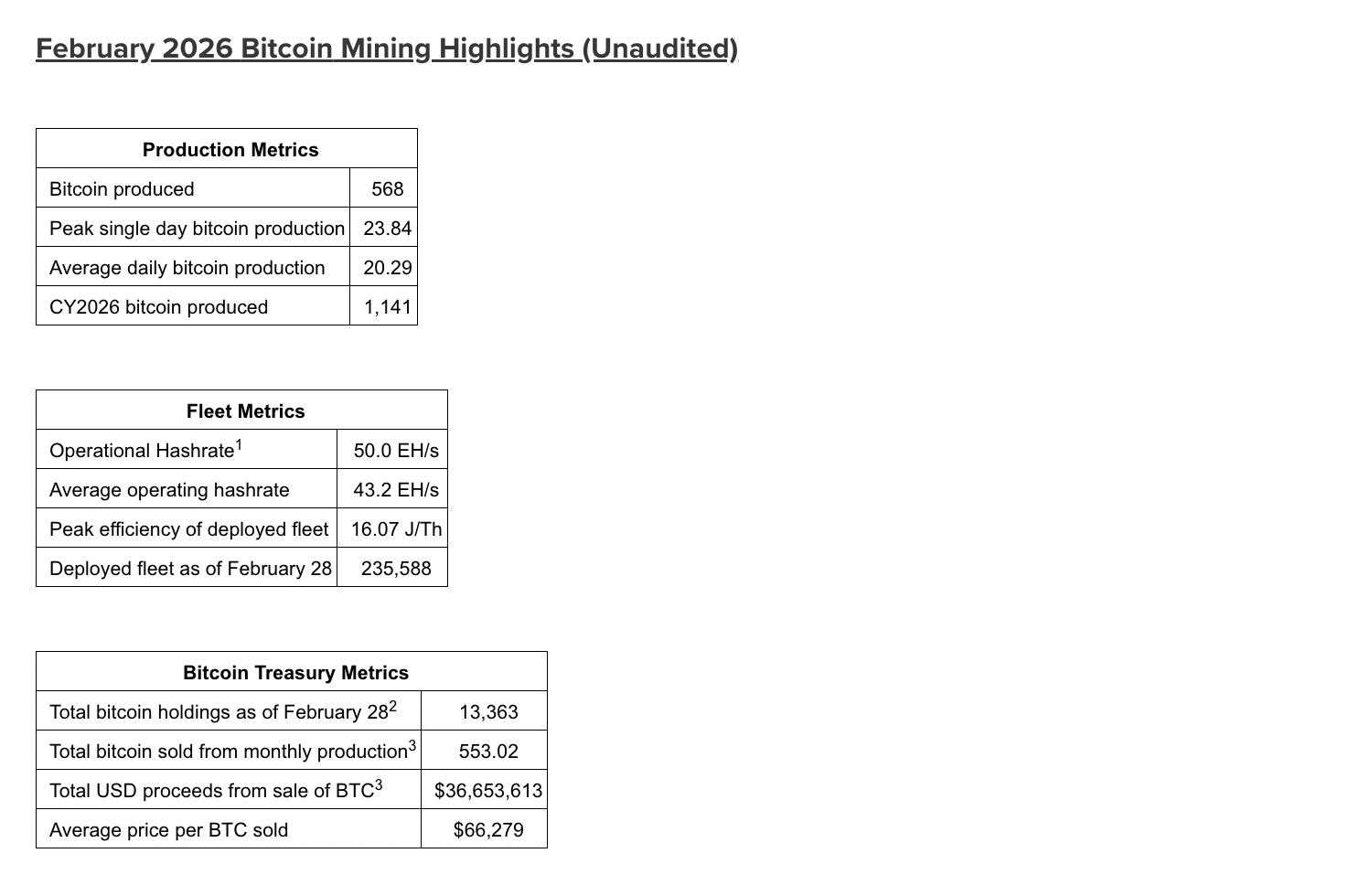
CleanSpark reported the production of 568 bitcoins during February. The figure raised the company’s year-to-date total to 1,141 BTC.
The company also sold 553.02 BTC from its February output for about $36.6 million, based on an average price of $66,279 per coin. Data highlighted by ChainCatcher reflected the figures disclosed in the operational update.
By the end of the month, CleanSpark held 13,363 BTC in its treasury, according to BitcoinTreasuries data.
The company disclosed that 1,086 BTC from its holdings serve as collateral or receivable connected to derivatives transactions.
Production data also showed a peak single-day output of 23.84 BTC and an average daily production rate of 20.29 BTC.
Mining capacity and operational metrics
CleanSpark reported a peak operational hashrate of 50 EH/s during February, with an average operating hashrate of 43.2 EH/s. Hashrate measures the computing power deployed to secure the Bitcoin network.
The company operated a fleet of 235,588 mining machines at the end of the month. The deployed fleet achieved a peak efficiency of 16.07 joules per terahash.
Power resources remain a core component of the company’s growth strategy. CleanSpark controls 1.8 gigawatts of energy capacity under contract across its portfolio of sites in the United States.
Of that capacity, 808 megawatts currently support active mining operations.
The company said its strategy combines power infrastructure ownership with operational management of mining hardware.
Strategy combines cash flow and infrastructure growth
Schultz said the company aims to balance operational revenue with long-term infrastructure value.
"We run our balance sheet the same way we run our operations: with conviction," Schultz said. "Over the past 18 months, we have repurchased 20% of our own shares because we believe in what we are building."
The company also described a treasury strategy that mixes bitcoin sales with accumulation.
"We have a flexible treasury strategy, optimized by DAM, generating real cash flow," Schultz said. "We allocate deliberately, growing the portfolio and evolving our offering simultaneously, not sequentially."
The approach allows CleanSpark to fund operations while maintaining exposure to potential price increases in bitcoin.
"Our strategy remains consistent: generate predictable cash flow from disciplined mining operations today, monetize hyperscale-ready power and compute infrastructure through tenant-driven growth, and actively manage the balance sheet to preserve flexibility and amplify returns across cycles," Schultz said.
Infrastructure pivot toward AI and high-performance computing
CleanSpark has also prepared parts of its infrastructure to support artificial intelligence and high-performance computing workloads.
Several bitcoin mining companies have begun adapting power-dense data centers for these workloads as demand for large-scale computing grows.
The shift appears across the sector. For example, Riot Platforms disclosed that it sold 1,818 BTC in December for about $161.6 million as part of a strategy that includes monetizing data center infrastructure that can support AI workloads.
Other companies have also adjusted treasury strategies. Bitdeer reported that it sold its entire corporate bitcoin treasury during February after producing 189.8 BTC.
Bitdeer #BTC Weekly Update
— Bitdeer (@BitdeerOfficial) February 21, 2026
🔹 BTC Holdings: 0 (pure holdings, excluding customer deposits)
🔹 BTC Output: 189.8 BTC
🔹 BTC Sold: 189.8 BTC
🔹 Net BTC Added: -943.1 BTC
📅 Data as of February 20, 2026.#Bitcoin #BTC #BitcoinHoldings #BitcoinCommunity #BTCMining $BTDR pic.twitter.com/vtvBVEui0Q
Meanwhile, Core Scientific said during its fourth-quarter earnings call on March 2 that it sold about 1,900 BTC in January for roughly $175 million.
Market observers also monitored developments at MARA Holdings, one of the largest corporate bitcoin holders. The company holds more than 53,000 BTC on its balance sheet.
Robert Samuels, vice president of investor relations at MARA Holdings, rejected speculation about potential sales of its reserves in a post on X.
This assertion that @MARA has changed its strategy to sell the majority of our bitcoin holdings is factually incorrect.
— Robert Samuels (@RobSamuelsIR) March 3, 2026
Our 2026 10-K clearly states we expanded our strategy to allow for sales of bitcoin held on our balance sheet, meaning we may buy or sell from time to time… https://t.co/pyStJ3zfqx
CleanSpark’s latest operational update reflects how large mining companies continue to combine bitcoin production with infrastructure expansion. The sector has entered a phase where power contracts, computing capacity, and treasury management shape corporate strategy alongside raw mining output.
Disclaimer: All materials on this site are for informational purposes only. None of the material should be interpreted as investment advice. Please note that, despite the nature of much of the material created and hosted on this website, HODL FM operates as a media and informational platform, not a provider of financial advisory services. The opinions of authors and other contributors are their own and should not be taken as financial advice. If you require advice, HODL FM strongly recommends contacting a qualified industry professional.