






Bitcoin moved sharply higher on Tuesday after a sudden geopolitical shift reduced pressure across global markets. The cryptocurrency climbed past $72,500 for the first time in 20 days following confirmation that the United States and Iran agreed to a temporary ceasefire.
The move came within minutes of the announcement, which signaled a pause in escalating conflict tied to the Strait of Hormuz, one of the world’s most critical oil transit routes.
Ceasefire announcement triggers immediate market reaction
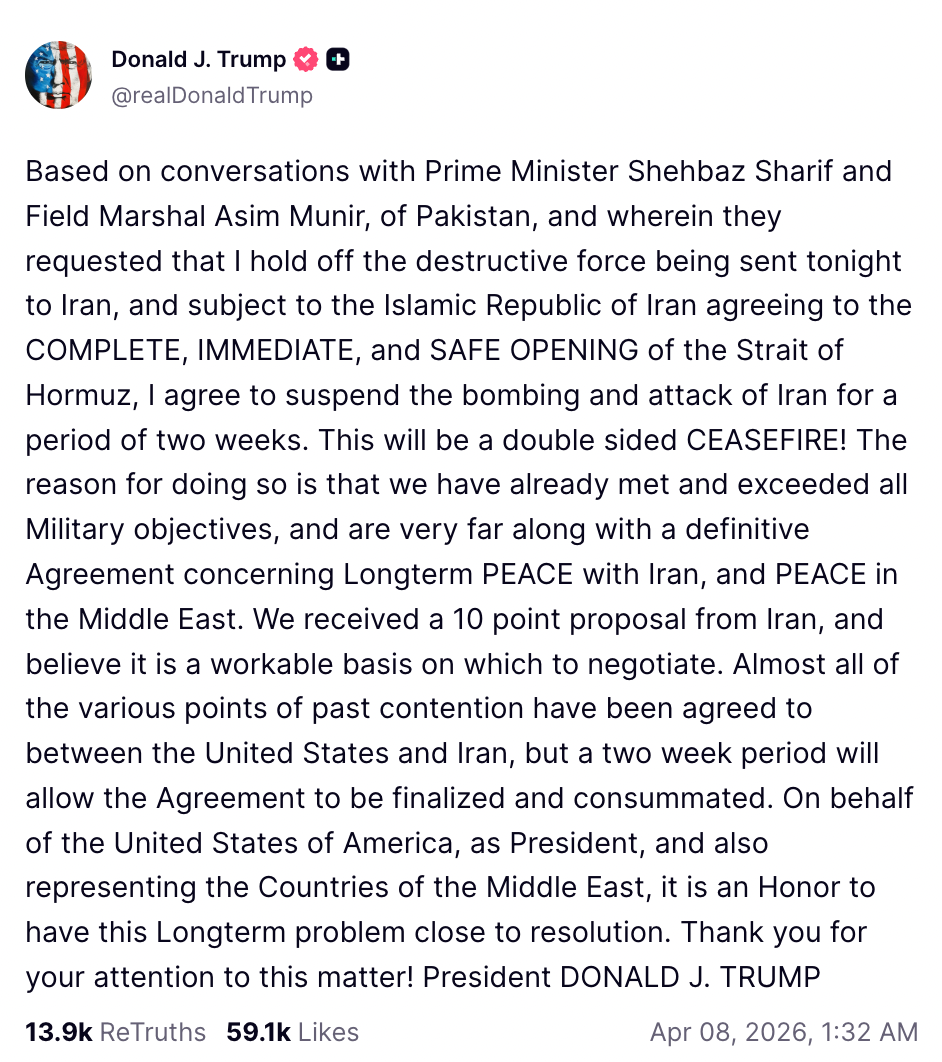
US President Donald Trump confirmed the development in a Truth Social post, stating:
“I agree to suspend the bombing and attack of Iran for a period of two weeks.” The statement arrived just hours before a deadline tied to Iran reopening the Strait of Hormuz.
Iran responded with conditional acceptance. Foreign Minister Abbas Araghchi said,
“If attacks against Iran are halted, our Powerful Armed Forces will cease their defensive operations.”
He added:
“For a period of two weeks, safe passage through the Strait of Hormuz will be possible via coordination with Iran’s Armed Forces and with due consideration of technical limitations.”
Markets reacted quickly. Bitcoin rose about 3% within an hour of the announcement and traded above $72,500, according to TradingView data. The broader crypto market followed. Ethereum gained around 6%, while XRP and Solana posted mid-single-digit increases. Total crypto market capitalization increased close to 4% over the same period, based on CoinMarketCap data.
The timing highlighted how closely digital assets track geopolitical risk. Earlier in the day, Bitcoin remained range-bound as traders weighed the possibility of imminent military escalation.
Volatility tied to Strait of Hormuz pressure
The Strait of Hormuz stood at the center of recent volatility. Iran’s restrictions on the passage disrupted oil flows and pushed crude prices higher, creating spillover effects across equities and crypto markets.
Trump previously warned of severe consequences if the route remained closed, stating that key Iranian infrastructure could face attacks. On Monday, he wrote:
“A whole civilization will die tonight, never to be brought back again.”
Hours later, the tone shifted toward diplomacy. Trump said the US had “met and exceeded all military objectives” and referenced a 10-point proposal from Iran as a basis for negotiation.
The easing of risk expectations drove a broader shift in sentiment. Oil prices dropped below $100 in after-hours trading, while US stock futures moved higher.
Bitcoin struggles to hold gains despite inflows
Despite the rally, underlying market signals show hesitation. Bitcoin failed to sustain levels above $70,000 earlier in the week, even as US-listed spot ETFs recorded $471 million in net inflows on Monday, the highest in more than five weeks.
Data from SoSoValue shows that ETF demand had remained muted in the prior two weeks, which raised concerns about the strength of institutional conviction. The US Bitcoin ETF had a net outflow of $157 million as of Tuesday.
At the same time, selling pressure from mining companies added to uncertainty. MARA Holdings transferred 250 BTC on Tuesday, according to Lookonchain. The company previously disclosed the sale of 15,133 BTC in March.
Riot Platforms also moved 1,500 BTC for sale in early April, based on Arkham data. These transactions fueled concerns that miners could continue liquidating reserves to manage costs and pivot toward AI data center investments.
Mixed sentiment limits upside expectations
Options markets reflected cautious positioning. Data from Deribit showed put options trading at a 17% premium over call options, which indicated strong demand for downside protection.
The Crypto Fear & Greed Index registered an “extreme fear” score of 17 on Wednesday, reinforcing the cautious tone among investors.
Michael van de Poppe, founder of MN Trading Capital, noted the market’s indecision before the rally:
“Well, because it did reject at $70K again, and it's having higher lows, with its recent higher low at $66.5K. This means that price is compressing and the markets are unsure which direction it wants to go.”
Even with the ceasefire-driven rebound, the broader outlook remains uncertain. A two-week pause does not resolve underlying geopolitical risks, and traders continue to watch whether negotiations progress or tensions return.
Short-term relief, long-term uncertainty
The latest price action reinforces Bitcoin’s sensitivity to macro developments. The asset often behaves like a risk asset during periods of crisis, declining when tensions rise and rebounding when conditions stabilize.
Tuesday’s move fits that pattern. A sharp shift from escalation to diplomacy triggered a relief rally, but the sustainability of gains depends on factors beyond geopolitics. Liquidity conditions, interest rate expectations, and consistent capital inflows remain critical.
For now, Bitcoin has reclaimed a key psychological level above $70,000. Whether it can maintain momentum above $72,000 or push toward $75,000 will depend on how the ceasefire holds and how markets interpret the next phase of negotiations.
 Tanya Petrusenko
Disclaimer: All materials on this site are for informational purposes only. None of the material should be interpreted as investment advice. Please note that, despite the nature of much of the material created and hosted on this website, HODL FM operates as a media and informational platform, not a provider of financial advisory services. The opinions of authors and other contributors are their own and should not be taken as financial advice. If you require advice, HODL FM strongly recommends contacting a qualified industry professional.