



Bitcoin hovered near a critical technical level on Monday after a weekend of geopolitical escalation in the Middle East. The asset traded around $66,400, close to the $65,000 support zone that traders have monitored over the past month. A decisive break below that threshold would open the door to a deeper correction.
The move followed coordinated U.S. and Israeli strikes on Iranian targets over the weekend and subsequent retaliatory actions across the region. BBC News reported explosions in Bahrain and Dubai and smoke near the U.S. embassy in Kuwait. Iran’s Islamic Revolutionary Guard Corps announced that no vessels may cross the Strait of Hormuz, a chokepoint that carries a significant share of global oil supply.
Oil prices reacted sharply, with Brent crude rising toward $80 per barrel and U.S. WTI gaining between 7% and 8%. Gold climbed more than 2% to $5,388 per troy ounce. Silver also advanced. The shift into traditional safe-haven assets underscored the risk-off tone that marked the start of the week.
Bitcoin briefly fell to $63,000 over the weekend before recovering part of the loss. As of Monday, it was down roughly 2% on the day, according to CoinGecko data. U.S. equity-index futures showed steeper declines, with Nasdaq, Dow, and S&P 500 contracts down more than 1% ahead of the U.S. open.
Ryan McMillin, chief investment officer at Merkle Tree Capital, described the reaction as typical during periods of uncertainty.
“Bitcoin's initial sell-off was almost textbook; markets hate uncertainty more than bad news, and the moment the Iran conflict looked contained, the reflexive bid came back fast,” he said.
The Fear and Greed index reading is 10 and Bitcoin futures funding rates are at -6%, a level not seen since Bitcoin traded at $16,000 in 2022.
Technical levels frame short-term outlook
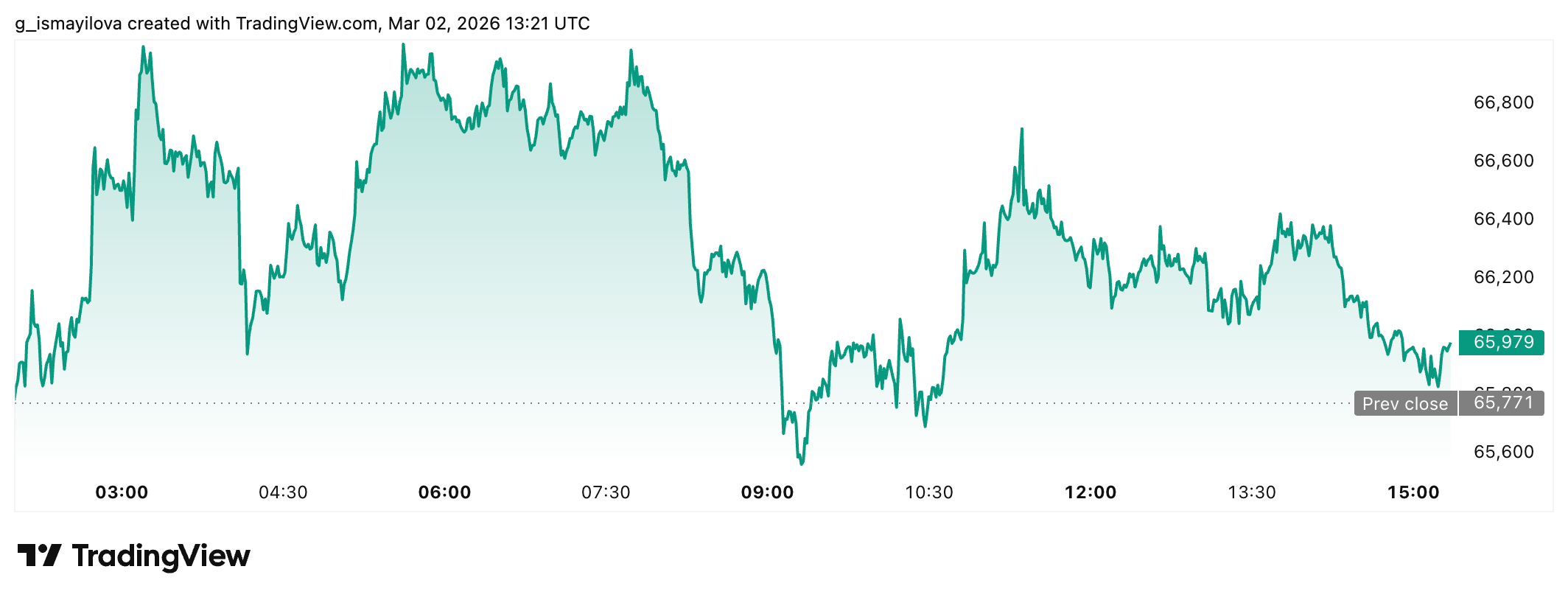
On the four-hour chart, Bitcoin holds above its 50-period exponential moving average while facing resistance near the descending 100-period EMA around $67,650. A break above that zone would expose $69,000 and then the upper consolidation boundary near $71,700. A drop below $63,000 would place $60,000 and $58,822 into focus.
Hayes ties war cycle to Fed policy
Arthur Hayes, chief investment officer of Maelstrom, framed the conflict in monetary terms. He argued that major U.S. military campaigns often precede Federal Reserve easing, as HodlFM reported.
“The time to back up the truck and buy Bitcoin and high-quality [altcoins] like HYPE is immediately after the Fed cuts rates and or prints money to support the government’s goals in Iran,” Hayes wrote.
He cited historical examples, including the 1990 Gulf War and the period after the September 11 attacks, when the Federal Reserve cut rates amid heightened uncertainty.
“The longer Trump engages in the extremely costly activity of Iranian nation-building, the higher the likelihood the Fed lowers the price and increases the quantity of money,” Hayes said. “The cure, as always, is cheaper and more plentiful money.”
Hayes’ view contrasts with the current price backdrop, as Bitcoin trades near $66,000, well below its October peak of $126,000.
Kalshi market controversy adds to volatility
The geopolitical shock also reverberated through prediction markets. Kalshi hosted a contract titled “Ali Khamenei out as Supreme Leader?” which accumulated more than $50 million in total volume, with about $20 million traded on Saturday alone, according to prediction market analyst Dustin Gouker.
Kalshi CEO Tarek Mansour addressed criticism on X.
“We don't list markets directly tied to death,” he wrote. “When there are markets where potential outcomes involve death, we design the rules to prevent people from profiting from death.”
Under the contract terms filed with the CFTC, if Khamenei died, positions would settle at the last-traded price prior to his death rather than resolve to a binary payout. Mansour said that price was recorded at 1:14 AM ET Saturday, and traders who entered after his death would receive refunds. The platform later acknowledged that prior settlement language was “grammatically ambiguous.”
The episode drew scrutiny from lawmakers. Six Democratic senators led by Adam Schiff sent a letter to CFTC Chairman Michael Selig that urged a ban on contracts that resolve on or correlate to an individual’s death. The CFTC faces a March 9 deadline to respond.
Bitcoin now sits at the intersection of geopolitical risk, monetary policy debate and speculative positioning. The next move hinges on whether $65,000 holds as support and whether oil-driven inflation fears intensify.
 Gunel Ismayilova
Disclaimer: All materials on this site are for informational purposes only. None of the material should be interpreted as investment advice. Please note that, despite the nature of much of the material created and hosted on this website, HODL FM operates as a media and informational platform, not a provider of financial advisory services. The opinions of authors and other contributors are their own and should not be taken as financial advice. If you require advice, HODL FM strongly recommends contacting a qualified industry professional.